
Strategy / THE EVENT OWNER’S VIEW
How to Compare Event Budgets and Agency Quotations
Compare the scope, assumptions and responsibilities behind each total. A useful budget makes trade-offs visible before they become event-day compromises.
Create one brief before comparing prices
Two quotations can have similar headings and describe very different events. One production line may include installation, operators and rehearsal; another may cover equipment for show time only. Comparing totals before aligning the scope rewards missing information rather than a better solution.
Issue the same working brief to each agency: objectives, proposed format, dates, venue status, audience size, programme, hospitality needs and decision timetable. Include what is still uncertain. If the venue has not been selected, ask each agency to state the assumptions used to prepare its estimate.
Create a comparison sheet with one row per required deliverable. Alongside price, record quantity or basis, included services, exclusions, assumptions and the party responsible. This becomes the shared reference for clarification rather than a chain of unrelated revised proposals.
Make the bill of quantities readable
A bill of quantities, or BOQ, should help the client understand what is being bought. Ask for descriptions clear enough to connect a cost to a function in the event: registration support, stage construction, screen content, speaker transport or dinner service. Technical detail can sit alongside the commercial description where it helps the specialist assess the scope.
Check whether quantities, durations, staffing and access assumptions are visible. Does a crew line cover setup, show and dismantling? Does content development include revisions and final playback preparation? Does a transport allocation depend on a stated number of journeys or operating hours?
The objective is not to prescribe every item before a creative concept exists. It is to distinguish a developed scope from an allowance and identify what information is required to turn the allowance into an approved commitment.
Separate fixed, per-guest and provisional costs
Some costs are linked mainly to the chosen event format and production scope. Others change with attendance, such as meals, accommodation or selected guest materials. Some remain provisional until a design, venue or supplier requirement is confirmed. Label these categories so an attendance change does not obscure the rest of the budget.
Avoid assuming every cost moves proportionally with guest count. An extra group may require another registration position, a room-layout change or additional transport rather than just more meals. Ask the agency to identify the points at which the operating plan would need to change.
Request a base scenario and, where useful, one clearly defined attendance or scope alternative. Compare the consequences as well as the cost. The alternative should state what changes for the guest and delivery team, not simply present a smaller total.
Inspect exclusions and duplicated responsibilities
Read exclusions as actively as the priced lines. Venue packages may cover some services while an agency estimate assumes the client will provide them. Conversely, two suppliers may both include the same function. Resolve overlaps and gaps before using the total as an approval figure.
Check access and overtime, delivery and collection, rehearsals, permissions that the venue requires, power arrangements, internet, content preparation, crew hospitality, storage and removal. Not every item applies to every event; the useful question is whether someone has assessed and assigned it.
Record the agreed owner for each requirement: venue, agency, client or specialist supplier. A zero against an item should mean a documented inclusion or deliberate exclusion, not an unanswered question. Ask the agency to identify dependencies on information or services that the client must supply.
Understand fees and compare commercial terms
Ask how agency planning and management services are represented and what responsibilities they cover. The commercial structure should let you understand the scope of coordination, creative development, supplier management and event-day oversight. Clarify how additional work is approved and charged.
Review payment milestones, quotation validity, cancellation or postponement terms, and deadlines for final numbers with the person responsible for commercial approval. A lower headline figure can carry different assumptions about timing, availability or change costs. Compare those conditions alongside the delivery scope.
Keep taxes and other statutory charges clearly identified in the quotation and have their treatment checked by the appropriate finance adviser. Do not infer an all-in commitment from a subtotal. The approved record should make clear what amount is being approved and what remains subject to confirmation.
Protect the budget through revision control
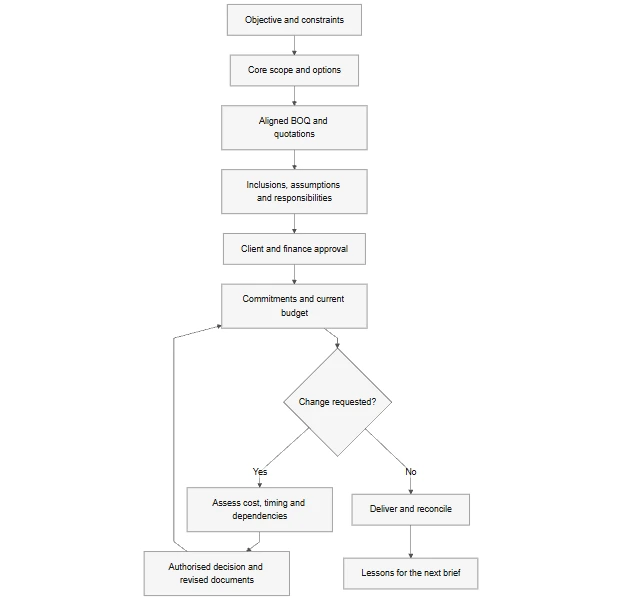
Use a single budget owner and a dated master version. Every requested change should show the reason, cost effect, operational effect and approval status before the relevant commitment is made. Distribute the approved version to the people who need to act on it.
For illustration, adding an awards segment may affect trophies, scripting, graphics, rehearsal, show duration and dinner timing. Treating it as one small stage addition can miss several linked changes. Ask the event lead to trace those dependencies and return one consolidated change proposal.
Maintain a change log rather than silently replacing numbers. Mark items as estimated, approved or committed so the client can distinguish an idea from an order. Reconcile supplier changes with the master budget; an email agreement should not remain invisible to the person approving the total.
Use contingency for identified uncertainty
Discuss contingency in relation to the event's open risks, rather than presenting it as permission to spend. Unconfirmed attendance, unresolved access arrangements or an evolving programme may create different exposures. Record what the allowance is intended to cover and who can authorise its use.
Ask which decisions would reduce uncertainty now. Confirming the room layout, collecting speaker requirements or agreeing guest deadlines may be more useful than carrying an unexplained allowance. Keep scope improvements separate from responses to a genuine change in conditions.
Before approval, the budget pack should include the aligned BOQ, assumptions and exclusions, responsibility matrix, payment milestones, change process and open-risk list. The strongest comparison is the one that shows what each option will deliver, what could change and how the client remains in control.
Put the plan to work
Adapt these working tools to your event, venue and agreed responsibilities.
- BOQ and quotation comparison worksheet