
Review / THE EVENT OWNER’S VIEW
Make the Post-Event Review Useful for the Next Brief
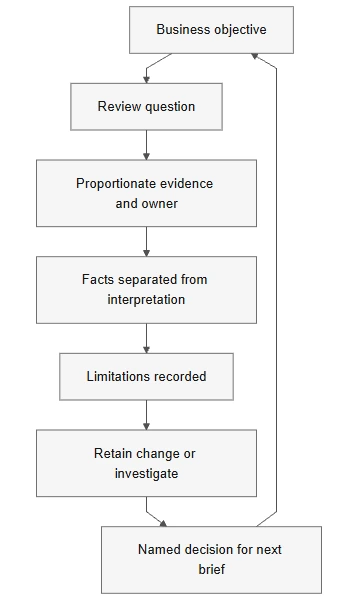
Connect business objectives to proportionate evidence, separate facts from interpretations and assign the follow-up that turns observations into decisions.
Decide what evidence matters before the event
A useful review begins in the brief. State the primary objective, then ask what evidence could reasonably help assess it. If the purpose is understanding, relevant questions and feedback about clarity may help. If the purpose is conversation, requested follow-ups and the quality of discussion may be worth recording. Attendance describes participation, but it does not independently prove either objective was achieved.
Agree the evidence owner, collection method, timing and limitations. Keep the method proportionate to the event and the organisation's information-handling arrangements. Do not collect personal detail merely because a platform allows it. The client sponsor approves the evaluation question; the relevant business team owns any later commercial assessment.
Write down what the evidence cannot establish. A guest's stated intention is not the same as an action. A count of scans is not necessarily a count of meaningful conversations. Recognising those limits makes the report more useful, because it prevents an attractive number from becoming an unsupported claim.
Separate delivery, experience and business questions
Review three connected but different areas. Delivery asks whether the agreed scope and handovers were completed. Experience asks what guests encountered and how that supported or obstructed participation. Business assessment asks what the event contributed to the original objective, using evidence appropriate to that question.
A technically completed programme may still contain confusing transitions. Positive comments about hospitality may coexist with unanswered content questions. A later commercial result may depend on factors beyond the event. Keep these distinctions in the review instead of reducing everything to a single success label.
Assign owners who can interpret each area. Delivery leads contribute operational records; the guest or programme owner reviews experience observations; the client business owner evaluates relevant follow-up. The event lead consolidates the discussion without presenting unverified causation. This division supports accountability while avoiding the claim that every favourable later outcome was produced by the event.
Use an evidence register rather than a highlight reel
For each review question, record the observation or data, source, date, limitation and proposed interpretation. Mark whether an entry is verified, partial or still awaiting confirmation. Keep photographs and anecdotes in their proper role: they can illustrate a moment, but they do not replace evidence of a stated objective.
For a hypothetical conference intended to generate priorities, an agreed workshop output and its assigned next decision may be relevant. A photograph of a busy breakout room shows activity but does not establish the quality or adoption of those priorities. This is an illustrative distinction, not an account of a completed project.
Ask whether the record includes less visible moments as well as the main stage. Registration queries, unclear directions and missed handovers can explain experience problems more precisely than a general satisfaction statement. Capture the moment and consequence without attributing motives to guests or blaming an individual from incomplete information. The review owner checks important claims before they enter a client report.
Ask short questions that can inform a decision
Design feedback around the next decision. Ask what was useful, what was unclear and what information or action guests still need. Avoid a long questionnaire that gathers opinions nobody is responsible for using. If a score is collected, retain the question wording and context so it is not detached from what respondents actually assessed.
Consider who responded and who did not. Feedback from a self-selected group may be useful without representing every attendee. Report that limitation plainly rather than turning a response count into a universal verdict. Do not invent a benchmark or performance target after seeing the results.
The client owner approves guest-facing questions and the communication route. The review lead decides how responses will be summarised and which questions need a direct answer. If a guest asks for support or a promised resource, assign that action separately from the statistical summary. An enquiry should not disappear inside an aggregate report.
Reconcile scope, assets and outstanding commitments
Close operational and commercial items alongside the experience discussion. Record outstanding supplier deliverables, approved changes, returned items, promised content and unresolved handovers. The relevant commercial owner reviews financial reconciliation; the event report should not imply that an estimate is a final agreed amount.
Keep an asset register identifying what was delivered, what may be shared and who approves release. The version used on stage is not automatically the version approved for public distribution. Confirm captions, names and any sensitive content before using materials in follow-up or future marketing.
The close-out gate is a visible list of completed and outstanding commitments with owners. An event can have ended while several actions remain open. Mark that status honestly rather than declaring closure because a debrief meeting occurred. Use Gifting and Post-Event Communication: Finish the Guest Promise for guest communication and gifting commitments that require their own reconciliation.
Turn observations into decisions for the next brief
Structure the conclusion as retain, change and investigate. A retained practice needs a reason; a proposed change needs an owner and a decision date; an unanswered question needs a way to resolve it. Keep the recommendation specific enough to use. 'Improve communication' is weaker than 'confirm the receiving room before the host announces the dinner transition'.
Distinguish an isolated exception from a recurring planning issue. Ask what information was missing, when it became available and which earlier decision could have helped. This keeps the discussion focused on the system of handovers rather than retrospective certainty about what someone should have known.
Carry approved learning into the next brief with its context. A layout that worked for one format may not suit another. Preserve the relevant assumptions, not only the final file. The review becomes valuable when it changes a future choice; it should not remain a polished document that nobody consults.
Questions about impact and reporting
Can we calculate a return on the event? Only with an agreed definition, appropriate cost information and a defensible method for linking the relevant result to the event. The client business and finance owners should approve that method. Do not treat revenue near the event date as automatically caused by it.
Is attendance still useful? Yes, when its definition and source are clear. It describes one part of the event and should be interpreted alongside the objective, not used as a universal success measure.
When should the review happen? Agree practical checkpoints for fresh operational observations and later business follow-up. The right timing depends on what is being assessed; it is not one universal deadline.
Begin with the evidence-and-action worksheet and Build an Event Brief That Makes Decisions Easier. For a planning discussion that includes the review from the start, contact hello@threesixzero.live.
Put the plan to work
Adapt these working tools to your event, venue and agreed responsibilities.
- Event evidence and action worksheet