
Guest experience / THE EVENT OWNER’S VIEW
From Invitation to Registration: Plan the Arrival Before the Queue
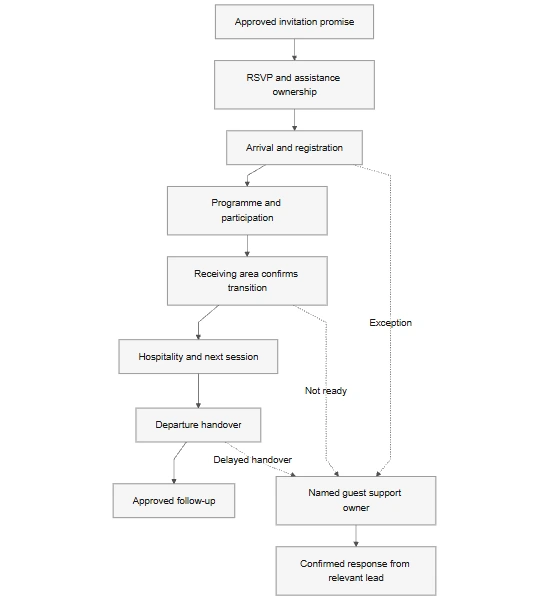
Connect invitation promises, RSVP ownership, registration testing and an exception route, including a hypothetical simultaneous arrival of 500 guests.
Choose an invitation strategy from the audience
Begin with who needs to attend and why. An invitation to a decision-maker, an employee or a partner group may need different context, but the event's confirmed facts should remain consistent. Identify the audience owner who approves the list, the message owner who approves the invitation and the guest lead who manages responses.
Decide whether the communication is a save-the-date, a full invitation or a confirmed-attendance update. Do not imply that a venue, demonstration or travel arrangement is settled when it is still provisional. Every message should explain what action is requested and where questions go.
Before release, check event name, date, location, arrival time, programme start, response instructions and assistance contact. Confirm how changes will be communicated. The invitation gate is an approved promise to the guest, not merely an approved design. Connect that promise to Build an Event Brief That Makes Decisions Easier and Design the Event Around the Guest Journey.
Maintain one response record with clear statuses
Use a master guest record that distinguishes invited, responded, confirmed, declined and unresolved entries in terms appropriate to the event. Agree what confirmation means before sending it. A submitted interest form may not equal a confirmed place if the event has a separate allocation decision.
Record the source and owner of changes. If stakeholder teams maintain their own lists, establish a controlled reconciliation process rather than merging competing spreadsheets during arrival. Give access according to role and the organisation's information-handling arrangements. Do not distribute a full guest list to someone who only needs to arrange one service.
Set useful review points for unconfirmed attendance, assistance requests and venue numbers. These dates depend on actual supplier and programme commitments. The guest lead reports assumptions as assumptions, so the client can approve a working attendance scenario without mistaking it for a final count.
Select a registration system by the transaction
Describe what registration must do before choosing software. Does it confirm attendance, issue a badge, allocate a session or direct a guest to a host? Each additional action changes the interaction and the information required. Keep optional activity from blocking the main arrival flow where a separate route is feasible.
Ask the provider to explain the intended normal process, exception process, connectivity requirements and fallback. Test the actual configuration with representative records and devices. Relevant technical owners should assess reliability and support; a generic product description is not evidence that the event setup is ready.
Include data correction, duplicate records, missing confirmations and late additions in the test. Agree who can authorise entry when a record is missing. Registration staff should not be left to make an unbriefed guest-eligibility decision. The release gate confirms the record version, decision rights, tested process and the help route.
Answer how long registration should take with a test
There is no universal registration duration. A simple name confirmation and a transaction involving badge correction, session choice and payment are different tasks. Instead of publishing a fixed promise, define the intended normal interaction and observe it in a realistic rehearsal.
Record what was tested, the conditions, where uncertainty occurred and what changed afterwards. Consider the likely arrival pattern as well as individual interactions. A process that seems quick for one person may still create waiting when a large group arrives together or when many records need correction.
The guest lead uses the findings to revise the process; the provider confirms system implications; the venue reviews space and routes. Agree what guests will be told if waiting develops and who monitors the area. Do not turn a small test into a guaranteed service rate. Its purpose is to reveal decisions and dependencies before doors open.
Plan for 500 or more guests without promising no queues
A 500-plus guest list should prompt questions about arrival concentration, not a universal desk ratio. Review invitation timing, shared transport, venue entry and programme expectations. If every guest has the same arrival cue, the plan should consider concentrated demand rather than assume an even flow.
Separate the ordinary check-in path from enquiries when the reviewed layout allows it. Give guests enough information to choose the right route before reaching the front. The venue should assess queue space and the relationship with entrances, other functions and circulation. Do not create a holding arrangement that has not been reviewed simply to keep the registration desk looking clear.
The operating plan names the arrival monitor, exception owner, venue contact and escalation lead. It also identifies the conditions that require a change in the process. These are event-specific decisions developed with the responsible owners. The credible aim is a tested, observed and adaptable arrival, not an unsupported guarantee of zero waiting.
Scenario: 500 guests arrive at the same time
Imagine shared transfers bringing 500 guests into the arrival area close together. This is hypothetical, not a tested capacity scenario. The risk is concentrated demand across drop-off, registration and onward movement. A common failure is to focus only on scanning speed while transport continues to release guests into an already constrained area.
The guest lead and transport owner establish the actual arrival situation; the venue contact confirms the available, reviewed routes and spaces. The event lead coordinates a response that may involve revised vehicle release, clearer routing and a separate exception process where approved. The programme owner is told if opening timing may be affected.
The contingency must be agreed with the venue and relevant owners in advance, including how guests receive an update and where assistance is available. Do not improvise a new crowd-holding area or assume additional desks solve every constraint. The intended outcome is coordinated information and controlled handovers. Record observations afterwards to improve the next arrival plan.
Prepare guest communications for changes and exceptions
Prepare concise messages for confirmed changes: revised entry, delayed opening, different room or transport update. Keep the practical action first. Avoid speculative timing and avoid sending several teams' interpretations to guests. The guest lead owns the confirmed message, with the relevant operational owner supplying the facts.
Give hosts a short briefing covering event names, spaces, timings, assistance contact and exception authority. Update the briefing when the plan changes. A printed desk sheet or controlled digital view can support the team, but it must have a clear current version.
After arrival, record attendance according to the agreed definition and reconcile unresolved records. Do not silently turn a registration discrepancy into a claim that someone attended or did not attend. Share only the information needed for the agreed follow-up. Related transport and VIP handovers are covered in Travel, VIPs and Departure: Connect Every Guest Handover.
Questions before registration opens
Is a QR code enough? It can support a process, but guests still need clear instructions, a current record and help when the normal transaction fails.
Can late guests be added? Agree who authorises additions and how the decision reaches registration, hospitality and any other affected service. A new record may change more than the badge list.
Should reminders contain every event detail? Prioritise the current practical information and a reliable place to ask questions. Keep the message usable rather than repeating an entire programme in every update.
Use the registration test and arrival worksheet to document the plan. For an integrated guest-arrival discussion, contact hello@threesixzero.live.
Put the plan to work
Adapt these working tools to your event, venue and agreed responsibilities.
- Invitation, RSVP and registration test sheet