
Design / THE EVENT OWNER’S VIEW
Design the Event Around the Guest Journey
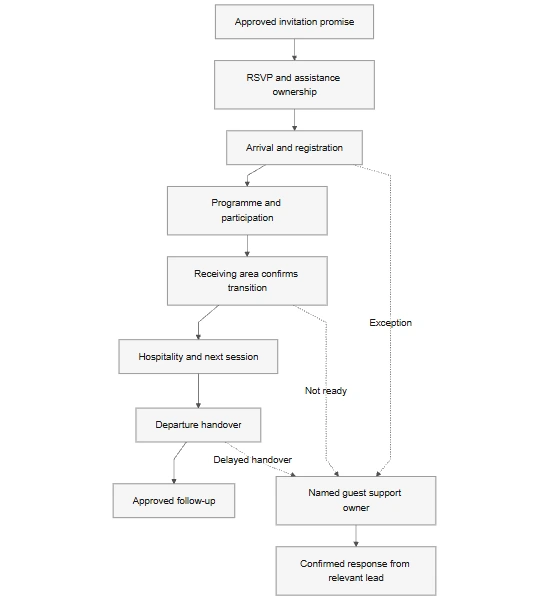
Build backwards from the guest's first message, first ten minutes, programme transitions and departure, with an owner for every handover.
Start with the journey, not the touchpoint list
A guest experiences one event even when several teams deliver it. The invitation, entrance, registration, programme, refreshments and departure need to explain the same purpose and the same next steps. A journey map connects those moments through decisions, responsibilities and information rather than treating each as a separate branding opportunity.
Choose representative guest situations: a first-time visitor, someone arriving with a group, a speaker and a guest who has requested assistance. Use only situations relevant to the brief. Walk through what each person needs to know and who helps when the normal route does not work.
The guest lead owns the map, while venue, programme, hospitality and transport leads confirm their parts. The client approves the intended experience and any scope trade-offs. The output should show the moment, guest question, planned response, owner and dependency. A decorative diagram without those decisions will not help a host answer a practical question on the day.
Plan the first ten minutes as an illustrative walkthrough
The first ten minutes is a useful observation window, not a service guarantee. Imagine a guest reaching the property, locating the correct entrance, understanding registration and deciding where to go next. What information is visible at each point? Where can they ask for help without joining the wrong queue? What happens if they arrive before the room is ready?
Start outside the event room. Confirm the property entry, drop-off instructions and route with the venue. Use consistent names for spaces in invitations, signs and staff briefings. An elegant event title is less useful at an entrance if the venue team recognises only a different booking name.
Walk the route from a guest's perspective before opening. Check whether temporary furniture, another function or service activity changes the plan. The guest lead records exceptions and the venue owner confirms workable alternatives. The intended outcome is orientation and a clear welcome, not a promise that every guest will complete arrival in a fixed number of minutes.
Make wayfinding a sequence of decisions
Place information where a guest must choose a direction or action. Explain the destination before a junction, then confirm it after the turn where useful. Avoid expecting a single entrance sign to explain the whole property. Use language that matches the programme and the guest communication.
Ask the venue to review placements and routes, including accessible routes and areas shared with other functions. Hosts should know the route and where to obtain an answer they do not have. A host who redirects a guest confidently to the wrong space can create more confusion than a missing sign.
Assign an owner for updates if a room changes. Signs, announcements, programme screens and staff instructions must change together. Keep one confirmed location record rather than allowing each team to use its own room names. The approval gate is a walked route and a briefing that connects each decision point to the current plan.
Give participation and attention a place in the programme
Attention is shaped by relevance, clarity, comfort, participation and the rhythm of the programme. There is no single session length that suits every audience. Ask what guests are doing at each stage: listening, discussing, trying something, reflecting or moving. If the agenda repeats one mode for a long period, assess whether it still serves the objective.
Participation needs instructions and a host. A discussion prompt should say what to consider, how long the activity is intended to last and what happens to the response. Seating should support the activity, subject to venue and layout review. Do not select a table format solely because it looks sociable if guests spend the session trying to see a presentation.
The programme owner approves the rhythm and output of each activity. The guest lead checks whether instructions and movement are understandable. Use Networking, Attention and the Spaces Between Sessions for designed networking and break planning rather than adding an unexplained networking slot to the agenda.
Design the handovers around food, rooms and departure
Transitions need both a releasing owner and a receiving owner. Before guests leave a conference room for dinner, someone must confirm that the destination, service and directions are ready. If a room reset is required, identify where guests wait and what they can do there. The programme should account for the movement instead of treating the end of a session as the start of service.
Coffee breaks also have a journey: approach, choose, collect, move away and return. The banquet lead assesses the service arrangement; the guest lead connects it to circulation and information. Dietary assistance should have a clear route agreed with the provider rather than rely on a general reassurance from any available host.
Departure begins before the closing announcement. Confirm transport information, collection points, guest assistance and the response to a delayed vehicle or missing item. Coordinate with the venue and transport owner. The closing message should tell guests the confirmed next step, including where to obtain help.
Build an exception route into every important moment
A useful journey plan describes normal flow and what happens when it is interrupted. A missing registration record needs a help route. A guest requesting assistance needs a responsible contact. An unavailable room needs a confirmed alternative or a clear update. These arrangements should be proportionate to the event and reviewed by the relevant owners.
Consider a hypothetical guest arriving while the programme has changed rooms. The risk is inconsistent directions. A common failure is to update a screen but leave hosts with the previous instruction. The guest lead confirms the new location, updates the shared record and briefs the affected points. The intended outcome is one coherent route, not a claim that no guest will ever need help.
Use the journey map in the final briefing. Ask each lead to explain the handover they receive and the handover they give. That exercise exposes gaps which separate checklists can miss. Keep unresolved dependencies visible at the readiness decision.
Questions for a useful guest-journey review
Does better guest experience require more décor? Not necessarily. Clear arrival information, relevant content and coordinated transitions may be more important for the brief. Assess each addition against the guest need it serves.
How do we review the journey? Collect specific observations at decision points and ask concise questions relevant to the objective. Separate what was observed from what is assumed about guest satisfaction.
What should we plan first? Start with the invitation promise and the desired closing action, then connect the steps between them. Use From Invitation to Registration: Plan the Arrival Before the Queue, Travel, VIPs and Departure: Connect Every Guest Handover and Make the Post-Event Review Useful for the Next Brief for deeper working detail. Bring your rough journey map to the planning conversation at hello@threesixzero.live.
Put the plan to work
Adapt these working tools to your event, venue and agreed responsibilities.
- Guest journey and transition worksheet