Operations / THE EVENT OWNER’S VIEW
When the Event Conditions Change: Access, Guests, Weather and Power
Work through hypothetical changes to venue access, attendance, weather and power with decision owners and feasible contingencies.
Plan the decision while there is still a choice
These are hypothetical planning scenarios, not completed case studies. They show how an event owner can connect commercial choices to venue, production and guest consequences. The numbers are illustrative and are not operating thresholds. Adapt each response with the venue and responsible specialists before using it for an event.
A contingency should name the information needed, the decision owner, the deadline and the affected teams. It should also say when the proposed event cannot proceed in its current form. Keeping an alternative on paper is useful only if there is still enough time and authority to implement it.
Scenario: the venue changes load-in, leaving only six hours
Situation: the agreed access arrangement changes and the ballroom becomes usable only six hours before the planned opening. Risk: installation, checks and rehearsal may no longer fit. A common failure is to preserve every original element and treat rehearsal as the time available for recovery.
Planned response: the venue representative confirms exactly what changed: unloading, room access, shared routes or the handover itself. The production lead rebuilds the remaining sequence with supplier leads, identifying prerequisites and the work that can be prepared elsewhere with permission. The event lead presents a feasible scope and any commercial or programme implications to the client approver. More people are not an automatic answer where the same space or dependency constrains the work.
Contingency: an agreed simplification, additional confirmed access or a programme revision may be possible. Relevant safety and readiness checks remain necessary. If the scope cannot be completed appropriately, the decision must reflect that rather than relying on optimism. Record the revised access conditions and distribute the replacement schedule with the changed handovers identified.
Intended outcome: the client accepts an event plan that fits the actual conditions. The existing critical-path guide develops this scenario in more detail, including approval dependencies and readiness gates. Six hours is not presented as either sufficient or insufficient for every event; only the assessed scope and conditions can determine that.
Scenario: the client adds one hundred guests on event day
Situation: the client asks to accommodate one hundred additional people. Risk: the change can affect the approved layout, permitted capacity, registration, catering, staffing and transport. A common failure is to regard it solely as another catering quantity or to add seats without reviewing the whole arrangement.
Planned response: the event lead obtains the actual change in attendance and timing, then asks the venue and guest, hospitality and production leads to assess the affected functions. The venue and relevant responsible specialists confirm what is permissible and feasible; the client approver receives the available choices and costs. Guest count alone does not establish that the space can accommodate the change.
Contingency: if the additional attendance cannot be accommodated in the agreed event, the client needs a clear alternative, which might include an appropriately planned separate arrangement or revised invitation handling. An overflow space is not a ready solution unless its access, programme connection, staffing and other requirements have been assessed. The guest-experience team owns communications and registration changes; production confirms implications for the audience-facing programme and layout.
Intended outcome: one approved attendance plan reaches all leads before new instructions are issued. Record the revised count, affected scope, approval and guest communication owner. This protects against one department preparing for the increase while another continues operating the original plan.
Scenario: the outdoor forecast shows a seventy percent chance of rain
Situation: an illustrative forecast raises concern about an outdoor programme. Risk: a probability alone can be mistaken for a complete description of timing, severity or site impact. A common failure is to wait for visible rain before asking whether an alternative is still practical.
Planned response: the named weather-monitoring owner reviews current official information, including relevant IMD local forecasts and warnings for a Mumbai event. The venue and responsible specialists assess the implications for the site and proposed production. Establish who can decide to relocate, postpone, hold or stop, and by when each option must be chosen to remain workable. The client must understand that decision deadline before guests begin travelling.
Contingency: an indoor alternative needs a confirmed space, usable layout, guest communications and a production plan. It is not established merely by calling a nearby room the backup. Likewise, temporary shelter must not be assumed to resolve every weather risk. Event-specific thresholds and actions require competent assessment; this guide does not supply universal limits for wind, rainfall or equipment operation.
Intended outcome: decisions use current information and the actual site plan, with a clear instruction to guests and suppliers. Record the information source, review time, decision and next checkpoint. Seventy percent is a hypothetical prompt for planning, not a go/no-go rule.
Reference: Regional Meteorological Centre Mumbai
Scenario: the venue cannot support the proposed power requirement
Situation: the production review identifies that the proposed arrangement is not supported by the venue's confirmed electrical provision. Risk: an unresolved requirement can threaten feasibility and safety. A common failure is to assume a spare outlet or an improvised connection solves a capacity or distribution issue.
Planned response: the production lead and venue's responsible electrical representative review the requirement with qualified specialists. The event owner asks for the permitted options, constraints, lead time and approval needed. They should not be expected to calculate an electrical workaround. The integrated plan must reflect whatever arrangement those responsible parties approve.
Contingency: the options may include an appropriately designed alternative supply, a reduced production scope or a different venue arrangement. Their suitability is event-specific. If a safe, approved option is unavailable, the dependent scope cannot simply proceed unchanged. Separate the commercial approval from the technical approval: accepting a cost does not establish that an arrangement is suitable.
Intended outcome: the agreed production is matched to a confirmed, professionally assessed provision before execution. Record the decision owner, approved scope and remaining conditions. HSE's event electrical guidance is a general safety-planning reference here, not a statement of Indian legal requirements or a substitute for local professional assessment.
Reference: Electrical safety at events
Connect the response to the rest of the event
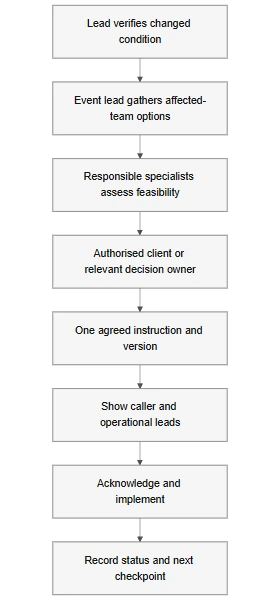
Each change must reach the people whose next action depends on it. A revised opening time affects guest communications; a different room affects wayfinding; a reduced scenic scope may affect content; and additional attendance can affect hospitality. Ask the event lead to issue one coordinated update with the effective version and the superseded instruction.
Use the dependency log to make the handover explicit. The person who approves a decision is not always the person who distributes it or confirms implementation. Record all three where necessary. A decision is not fully closed until the affected leads acknowledge what they will now do.
Review the assumptions before signing the scope
Ask which access condition, attendance figure, weather alternative or venue provision the proposal relies on. Those assumptions should be visible before vendors commit resources. If a condition is provisional, identify the date on which it must be confirmed and what happens if it changes.
Use these scenarios during the first coordination meeting as well as the final readiness review. Early discussion may prevent an unsuitable commitment; late discussion can only choose among the options still available. The intended value is informed accountability throughout planning, not a claim that any disruption can be recovered without consequence.
Put the plan to work
Adapt these working tools to your event, venue and agreed responsibilities.
- Event contingency matrix