
Operations / THE EVENT OWNER’S VIEW
Who Runs Show Day? Accountability Behind the Event
Understand the people, decision routes and readiness checks that connect the live programme to the wider event operation.
Twenty-four hours before an illustrative 1,000-person event
Imagine an event with 1,000 expected guests, several speakers and multiple delivery teams. The day before, the useful question is not whether everyone is busy. It is whether the next decisions, handovers and exceptions have owners. Guest count is illustrative; the same principle applies at smaller scales, with a proportionate team structure.
The event lead reviews access, the integrated schedule, approved content, speaker status and outstanding client decisions with the relevant leads. Each unresolved item needs a consequence and a next action. 'In progress' is not enough when another team is waiting for it. A short exception list can be more useful than circulating every completed task.
Planner, manager, producer and production company
These titles are used differently across businesses. A planner may shape the brief and arrangements; an event manager may coordinate delivery; a producer may own the programme's presentation; and a production company may supply technical resources or a wider managed service. The title does not establish which responsibilities are actually included in your agreement.
Ask who integrates the venue, production, hospitality and guest teams, and who remains accountable when their scopes overlap. Record the answer in a responsibility map. An event owner should not discover on show day that every supplier completed its own scope but no one owned the handover between them.
A single point of accountability means one lead returns with a coordinated position. It does not mean that person personally performs every task or replaces specialist authority. Safety, technical and venue decisions still require the relevant responsible people. The lead makes sure those inputs reach the decision and are communicated coherently.
What the show caller does—and when the role helps
The show caller coordinates the live programme's cues and transitions. A programme with videos, multiple speakers, lighting changes or coordinated entrances benefits from a clearly designated person controlling that sequence. The practical test is the number of interdependent moments and simultaneous responsibilities, not an arbitrary guest threshold.
The caller needs an approved running order, named contacts and a clear route for client changes. They should know whether the speaker is ready before releasing the introduction and whether the next content is confirmed before cueing it. In a simpler event, the programme lead may hold this role; the responsibilities still need to be explicit.
Avoid making the caller the default owner of every backstage problem. They need to follow the programme. A speaker liaison can resolve a missing person, while a technical lead investigates an issue and returns a concise status. This separation prevents a live sequence from losing its coordinating attention.
Control room and command centre serve different purposes
The production control position is where the relevant operators and programme coordination work. An event command centre, if the event needs one, brings together operational information and escalation. It might receive status from guest services, transport, venue and production. It is a function first; calling a room a command centre does not create a decision process.
Define what information each lead reports, when they report it and which exceptions require immediate escalation. The event lead needs a concise description of the issue, affected activity, available option and decision deadline. Routine updates should not overwhelm the channel needed for time-sensitive instructions.
Decide where the client approver can be reached. If the approver is on stage or travelling, name an authorised alternative with clear limits. A command centre with no decision authority can become a place where unresolved messages accumulate.
Coordinating twenty or more vendors
With many suppliers, the interface register matters as much as the supplier list. Record who hands what to whom, by when and in what condition. The person delivering furniture, for example, needs to know when the agreed space is available and who accepts the completed arrangement. Twenty vendors is an illustration of coordination complexity, not a claim about past ThreeSixZero events.
Group routine coordination through discipline leads while keeping the event lead accountable for cross-team decisions. Suppliers should receive the current schedule and the changes relevant to their work. A late update must identify the superseded instruction; simply sending another file can leave several versions in circulation.
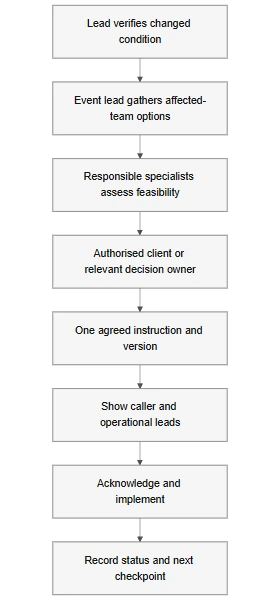
When an issue affects multiple scopes, collect the facts once and issue one agreed decision. Record any commercial approval separately from the operational instruction. This lets crews proceed with clarity while preserving a traceable account of what changed and who accepted it.
Thirty minutes before doors: a readiness conversation
A check thirty minutes before opening is an illustrative planning checkpoint, not a universal safety rule. Set the actual timing with the venue and responsible leads. Earlier checks must already have addressed work that cannot be resolved at the last moment. The final conversation confirms status and exceptions rather than starting the whole inspection process.
Confirm the live running order, approved presentation versions, speaker readiness, registration status, guest routes, hospitality readiness and escalation contacts. Each lead states whether their area is ready, ready with an agreed limitation or on hold. The event lead records any limitation and the decision it requires.
The relevant venue and specialist approvals must be respected. If opening is held, guest services and the host need a coordinated message. Do not let the presence of waiting guests become an informal substitute for a readiness decision. The intended result is one shared understanding of what can proceed.
Keep the live programme and the guest operation connected
A late keynote affects more than the stage. It may alter a meal transition, transport departure or another speaker's availability. The show caller assesses the running order; the event lead gathers the operational consequences; and the authorised client representative approves the relevant programme choice.
The guest-experience guide covers arrival design and simultaneous registration demand. The production interface is knowing who reports that the audience is ready and whether the opening cue should change. Likewise, hospitality reports readiness for dinner before the host directs guests into the next space. Each handover should have a sender, receiver and explicit confirmation.
Close with a controlled handover
Responsibility continues through departure, removal and venue handback. Confirm who releases suppliers and when shared routes become available. Record outstanding items rather than letting the last visible activity define completion. The production schedule should include this phase from the outset.
Collect concise notes from leads while decisions remain fresh. Use actual timings and recorded changes to improve the next brief; do not turn an operational debrief into an unsupported success claim. The editable run-of-show, dependency log and readiness checklist help make accountability visible before, during and after the event.
Put the plan to work
Adapt these working tools to your event, venue and agreed responsibilities.
- Run-of-show worksheet
- Pre-opening readiness worksheet