
Production / THE EVENT OWNER’S VIEW
Event Production Playbook
An event-owner playbook for the decisions, approvals, technical interfaces and handovers that turn a creative concept into a deliverable event.
Start with what the audience must be able to do
A production brief should describe the experience before it becomes a list of equipment. Does the audience need to read detailed information, watch a demonstration, hear an interview, participate remotely or move between rooms? Each requirement creates different decisions about the space, programme and technical support. A screen specification on its own cannot answer those questions. The event owner should explain what must work, while the relevant specialists determine how to deliver it.
Write a small set of acceptance statements. A guest in the agreed seating area must be able to follow the presentation. A remote speaker must be heard and understood by the room. The host must know when the next speaker is ready. These statements give proposals something useful to respond to. They also expose missing work: someone must own presentation preparation, remote-speaker checks and speaker movement, even if those items were absent from an initial equipment quotation.
This playbook is a planning framework, not an engineering specification. Its purpose is to help the client approve decisions in the right order, understand dependencies and commission appropriate specialist review. Event size alone does not determine complexity. A short executive announcement with remote participants may have more interdependent moments than a longer programme with a single presenter.
Translate the creative concept into a functional brief
Take each proposed creative element and ask what it requires from production and operations. A dramatic product reveal may affect stage access, rehearsal, camera coverage and when the product reaches the venue. An immersive entrance may compete with registration space. A branded stage may need to accommodate people with different access requirements. Capture these relationships before treating the design as final.
The creative lead describes the intended effect; production assesses feasibility; the venue confirms constraints; and the client approves the resulting scope. A visual should carry its status clearly: concept, under review or approved for execution. An attractive rendering should not silently become an instruction to fabricate before access, dimensions and supporting requirements have been resolved.
Maintain a requirement register linking each element to its purpose, owner, approval date and dependency. When the budget changes, this allows the team to discuss which experience to simplify rather than removing isolated items whose consequences are unclear. A decorative feature and a presentation confidence monitor may look equally removable on a spreadsheet, yet serve very different functions.
Make the venue part of the production decision
The production lead and venue representative should review the actual usable space, access arrangements and service constraints together. Ask for a coordinated layout showing the audience, stage, screens, control position and operational routes. Include the areas needed by crew and suppliers; a room cannot be assessed only by what appears in a guest-facing rendering.
Distinguish the delivery arrival time from usable room access. Confirm who hands over the ballroom, whether unloading can occur beforehand and which activities may take place in shared areas. Record the agreed conditions in the production schedule. If the access window changes, the team must reassess what can still be completed and checked; retaining the old scope does not make the lost time disappear.
For power, structural arrangements and other safety-critical requirements, ask the responsible specialists and venue to confirm suitability and required approvals. The event owner should receive a clear decision and any constraints, not attempt to calculate a workaround. Escalate unresolved requirements before contracting a design that depends on them. The related venue-evaluation guide covers the broader site visit; production planning turns those findings into delivery conditions.
Choose screens around the content and viewing positions
Decide what people will actually see: detailed slides, a filmed speaker, a product image or a decorative background. Then review the proposed display arrangement from the nearest, furthest and off-axis audience positions. AVIXA's display-size guidance considers the content and viewing environment, which is a useful reason to request a legibility review rather than choosing screen width from a photograph of another event.
LED and projection should be compared as complete proposals for the room. Ask how each option fits the content, surrounding light, placement, access schedule, installation requirements and budget. Avoid assuming either technology automatically solves every visibility problem. A very wide canvas can still show an ordinary slide in a small central area, while a large scenic screen may create new content-production work.
The client should approve a layout and representative content treatment together. Ask to see the longest likely heading, a typical chart and the actual aspect of the presentation inside the proposed design. Establish who adapts content and when that work must be complete. A screen decision made after every presentation has been designed can generate avoidable revisions.
Reference: Learn More About Display Size
Design lighting before fixing the decorative finish
Lighting discussions should include the speaker, audience, cameras, screens and intended atmosphere. Ask the creative and production leads to review those purposes together before décor is finalised. A finish selected only for its appearance in a rendering may behave differently under the event's lighting, and a decorative element can compete with the places where attention needs to go.
The client brief should describe moments: arrival, opening, presentation, discussion, reveal and transition to dinner. The lighting specialist then proposes the appropriate treatment within the venue's constraints. Review how speakers enter and leave, where photographs will happen and whether the room needs to change mood without interrupting guest movement. These are experience decisions, not instructions to select particular fixtures.
Confirm who approves the look during rehearsal and how late aesthetic changes will be handled. A request that appears small may affect several prepared cues. Separate essential visibility issues from optional refinements so the remaining rehearsal time is used deliberately. The goal is a coherent room in use, not simply a collection of attractive elements photographed before guests arrive.
Define who owns the complete production
Titles vary between organisations, so use responsibilities rather than assuming a label settles accountability. The event lead integrates the client, venue and delivery teams. A producer may shape the programme and its presentation. The production manager coordinates the delivery resources and schedule. Technical specialists design and operate their areas. A production company may supply several of these functions or only a defined package.
Name the person who owns the integrated production plan and the person who can approve commercial changes. These are not automatically the same person. Supplier leads should know where to raise a dependency or a missing decision. The client should know who returns with a coordinated recommendation instead of receiving separate questions from every department.
Keep this structure proportionate. A smaller event may combine roles, while a complex programme needs more dedicated ownership. The test is whether any person has simultaneous responsibilities they cannot reasonably perform. Someone escorting a keynote speaker cannot also be expected to remain at the control position for every cue. Make such conflicts visible during planning.
Build a production schedule with real handovers
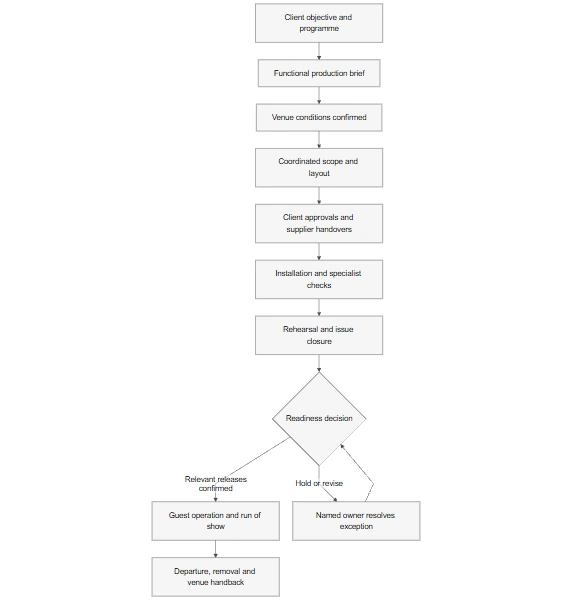
The production schedule covers preparation, deliveries, access, installation, checks, rehearsal, event operation and removal. For each activity, show its owner, location, prerequisite and handover condition. A supplier arrival is not the same as that supplier completing work. A task marked complete should mean the receiving team can actually proceed.
Work backwards from agreed guest readiness and forwards from confirmed venue access. If those two plans do not meet, the scope or conditions need to change. Do not balance the schedule by quietly removing checking time. Ask each lead what can be prepared earlier, what can run concurrently and what depends on the same room or route. The critical-path guide explains how a single blocked task can determine the overall finish.
Use one controlled schedule with relevant extracts for individual teams. Record the current version and when it was distributed. When a decision changes timings, identify the affected handovers explicitly. A new spreadsheet sent without a short explanation can leave people following familiar instructions from the previous version.
Distinguish the run of show from the production schedule
The run of show describes the audience-facing programme and the cues that make it happen. It includes speaker entrances, content starts, host links, transitions and other coordinated moments. The production schedule gets the event ready and closes it down. They connect at rehearsals and readiness gates, but neither should be expected to replace the other.
A usable run of show gives each moment a cue identifier, planned time or trigger, owner and relevant content reference. Record transitions, including the practical time for people to move, rather than listing sessions back to back. A panel does not appear simply because a keynote ends; furniture, participants and microphones may need a coordinated change.
The show caller or programme lead maintains the live sequence. Client changes should reach that person through the agreed approval route. Operators need a consistent instruction, while hospitality and guest teams need the consequences for their next activity. An event can recover from a revised running order more readily than from several departments acting on different versions of it.
Protect content through a controlled handover
Collect presentations, films, holding graphics, speaker names and pronunciation notes through one defined process. The client content approver confirms the message; the presentation owner controls versions and checks; the programme lead connects the content to the running order. These responsibilities should exist even when the event uses only a few files.
Agree normal submission dates and an exception route for necessary late changes. Keep an approved version available, but check that it remains acceptable if a replacement corrects inaccurate or sensitive material. Microsoft documents media-compatibility considerations in PowerPoint; opening a file on the sender's laptop is therefore not a substitute for checking the relevant content in the presentation setup.
Record which version is approved and which was actually delivered. If a deck is later distributed, obtain the required approval for that use rather than assuming the on-stage version can automatically be emailed. The presentation-change scenario explores the decision when a new file arrives minutes before stage; the principle is one approved version and one clear instruction.
Reference: Tips for improving audio and video playback and compatibility in PowerPoint
Give rehearsal a purpose and an owner
A technical rehearsal checks the coordinated operation of relevant production elements. A cue-to-cue rehearsal concentrates on transitions and cues rather than requiring every speech to run in full. A speaker rehearsal addresses the presenter's movement, content and interaction with the setup. Agree the purpose and participants in advance so the available time is not consumed deciding what to rehearse.
Use a rehearsal issue log with an owner and a closure decision for each item. Distinguish an issue that prevents the programme from working from an optional improvement. After a change, the relevant sequence may need another check. The client should understand what remains unverified before accepting a late addition.
Include the host, speaker liaison and operational handovers where they affect cues. A technical sequence may run correctly while the speaker is still in another room. Rehearsal is the point at which separate plans meet. Protect that function in the schedule rather than treating it as the space left after installation overruns.
Plan connectivity and backups as services with owners
List the activities that depend on connectivity: registration, remote speakers, live streaming, audience interaction or an online demonstration. For each, state where it operates, who uses it and what happens if it becomes unavailable. A hotel guest Wi-Fi password does not answer those operational questions. Ask the venue or network specialist for an event-specific assessment and support arrangement.
Cisco's high-density guidance distinguishes coverage from the demands of concentrated users and applications. At the client level, the useful action is to describe expected use and request verification for it, not to prescribe access-point counts. Decide which functions are essential and which can be paused. Agree who receives a connectivity incident and who communicates an alternative to guests or speakers.
Apply the same ownership to backup systems. Ask which failure each fallback addresses, how the team knows it is ready and who authorises its use. Two items are not necessarily independent just because both are listed in the quote. Technical specialists should assess shared dependencies; the client needs a clear account of the protected function and remaining limitations.
Reference: Wireless High Client Density Design Guide
Set a readiness decision before admitting guests
Define a readiness checkpoint with the venue, production, guest and hospitality leads. The question is whether the event can proceed in its agreed form, with unresolved items assessed and owned. A decorative finishing task and an unresolved safety concern are not equivalent. The event lead gathers status; responsible specialists and the venue retain their relevant approval roles.
An illustrative check thirty minutes before doors might confirm the current running order, speaker readiness, approved content, registration status, guest routes and the escalation channel. That interval is a planning example, not a universal standard or a substitute for earlier checks. Complex events may require different gates and lead times.
Record any hold decision and who can release it. If opening is delayed, guest communications and hospitality need a coordinated instruction. Do not let individual teams infer permission from seeing guests nearby. Readiness is a shared decision with defined evidence, not a mood created by a nearly finished room.
Prepare contingencies as decisions rather than promises
For each material risk, record the trigger, decision owner, affected teams and available response. A late speaker, failed display or changed access window requires different facts and different authority. Pre-agree acceptable programme alternatives where possible, including what the host can say and which content can be omitted or moved.
Weather and electrical suitability require current information and competent review. For Mumbai events, IMD provides official local forecasts and warnings that can inform the planning team. A forecast percentage by itself is not an operating threshold. The venue and relevant specialists should establish the event-specific decision process, including when there is still time to implement an alternative.
The contingency matrix should distinguish an optional adjustment from a hold or stop decision. Record the source of the latest information and the next review time. The intended outcome is controlled action when circumstances change, not a claim that every disruption can be made invisible to the audience.
Reference: Regional Meteorological Centre Mumbai
Close the production with evidence for the next brief
After the programme, keep ownership active through guest departure, supplier removal and venue handover. Confirm who can release equipment and when operational routes become available. A successful final cue is not the end of the production schedule. Outstanding damage, missing items or changes to removal arrangements need the same controlled communication as earlier work.
Collect the final running order, significant change decisions and concise notes from the leads. Separate observed facts from assumptions: a delayed session has a recorded duration, while its cause may need discussion. Review whether the brief, approvals, access conditions or handovers created avoidable pressure. Use those findings to improve the next plan rather than writing a generic success statement.
Before seeking quotations for your next event, share the programme purpose, venue conditions, likely content and approval structure. These inputs allow a production proposal to explain how the event will function. They also make it easier to compare scope and accountability, which is more useful than comparing equipment lists without their operating assumptions.
Questions to settle before the quotation is approved
Who is coordinating the scope between suppliers? Ask for the named lead, the interfaces they own and the decisions still required from you. A proposal can contain every necessary item while omitting the work of joining them together. Confirm that coordination is a defined responsibility with time in the plan.
What does the quoted backup protect? Request an explanation in terms of the event function, the planned response and any remaining dependency. Avoid accepting a generic assurance that everything has backup when the scope does not say what happens if the main function fails.
Can this scope fit the available access window? Ask for the sequence through installation, checks and rehearsal, not only the delivery time. If that sequence is conditional on early access, the condition belongs in the agreement and the contingency discussion.
What is the next decision that could affect cost or readiness? Keeping that question visible helps the client focus attention where it changes the outcome. Use the production schedule, dependency log and readiness checklist supplied with this playbook as working documents; adapt their owners and checkpoints to the actual event before circulation.
Put the plan to work
Adapt these working tools to your event, venue and agreed responsibilities.
- Run-of-show worksheet
- Production schedule worksheet
- Dependency and decision log
- Pre-opening readiness worksheet
- Event contingency matrix