
Operations / THE EVENT OWNER’S VIEW
The Run Sheet, Production Schedule and Dependency Log
Build a usable run sheet, production schedule and dependency log, with clear owners from load-in through venue handback.
Three documents answer three different questions
A run sheet explains what happens in the live programme. A production schedule explains how the event becomes ready and is handed back afterwards. A dependency log explains what must happen before another activity can proceed. They should share the same assumptions, but combining every detail into one enormous document can make the next action difficult to find.
The event lead owns the integrated view. Individual leads can receive practical extracts, provided the version and relevant changes remain clear. Start with the documents people need to make decisions and perform handovers, rather than measuring preparedness by the number of pages produced.
Build the run sheet around moments and transitions
For each programme moment, record an identifier, time or trigger, activity, owner and content reference. Include what must be confirmed before the cue. A host introduction may depend on the speaker being ready; a dinner announcement may depend on hospitality releasing the next space. Those conditions matter as much as the planned clock time.
Record transitions between sessions. A panel setup, speaker movement or audience change requires a plan even if nobody describes it as part of the show. The relevant leads should agree who confirms readiness and who gives the instruction. A running order that lists sessions without transitions can conceal the work connecting them.
The show caller or designated programme lead controls the live version. If a session moves, identify affected cues and communicate the resulting change to operational leads. Operators should not have to reconcile contradictory client messages while following the programme.
Build the production schedule around usable handovers
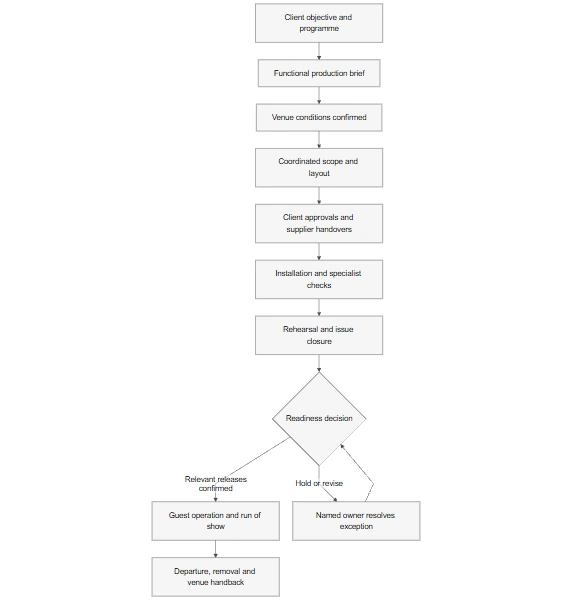
Begin with confirmed venue conditions and the required readiness point. Include access, unloading, installation, checks, rehearsals, guest operation, removal and handback. Show the location and owner of each activity, its prerequisite and what completion means to the receiving team.
A delivery slot is different from room access, and room access is different from a prepared work area. Ask the venue and suppliers to describe these stages accurately. If several teams use the same route or space, the schedule needs the agreed sequence rather than several overlapping assumptions.
Work backwards from opening and forwards from access. If the sequences conflict, raise that before approving scope. Reducing unallocated time on a spreadsheet does not create a feasible plan. The responsible leads must confirm what can genuinely overlap and which checks remain necessary.
What happens during load-in
Load-in is the controlled arrival and placement of the resources needed for the event. The venue contact confirms the agreed access and routes; supplier leads manage their deliveries and work; the production manager coordinates the sequence and cross-team handovers. It is not simply the time when every truck is told to arrive.
Before the day, confirm the booking process, receiving contact, permitted route, shared-area constraints and the destination of each delivery with the venue. The venue guide covers physical access assessment; the schedule converts those findings into who arrives when and who accepts the handover. Specialist safety arrangements remain with the responsible parties.
If a delivery is late, assess which downstream activity is blocked. Moving another supplier forward may help only if its prerequisites and space are available. Record the revised instruction and inform the receiving team. Avoid creating congestion by responding to uncertainty with more simultaneous arrivals.
The dependency log reveals the critical path
Write each dependency as an explicit relationship: a layout approval enables the relevant production work; a completed setup enables a check; an approved presentation enables the relevant rehearsal. Name the owner of the input and the owner waiting for it. Add the decision deadline and consequence if it is missed.
The critical path is the dependent sequence that determines the earliest completion. It can change as tasks close and new issues emerge. Review the current constraint at coordination meetings rather than assuming the initial plan remains accurate. The dedicated critical-path guide includes a restricted ballroom-access example.
A useful escalation states what is blocked, which options remain and when a choice is required. 'Urgent' on its own is less useful than explaining that an unapproved element now affects fabrication or the rehearsal sequence. The client approver should receive the consequence before the last practical decision point.
Scale adds interfaces, not just quantities
A larger event may add rooms, programme streams, access points, speakers or suppliers. Each additional interface can require another handover and another decision owner. Guest count is therefore an incomplete measure of production complexity. An event with several concurrent sessions needs a different coordination structure from one room with the same total attendance.
Use common milestones and identifiers across teams, then provide the detail each team needs. Name who resolves a conflict between schedules. With many vendors, a supplier list cannot substitute for an interface register: the important question is who receives the next completed piece of work and how they know it is ready.
Review role conflicts as the scope grows. A lead who can manage several sequential responsibilities may not be able to manage them concurrently. Add or redistribute ownership when the work demands it, rather than retaining a small-event structure solely because the titles look complete.
Version control should be simple enough to follow
Put the event name, date, document owner, version and issue time on each working document. Keep a short change note identifying the affected activity or cue and the instruction it replaces. The distribution list should reflect who must act, not merely who may be interested.
At a briefing, confirm the version being used and the next handover for each lead. After a material change, ask affected owners to acknowledge it. A file sent is not necessarily an instruction received. Keep significant approvals in the decision record so the operational update has a traceable basis.
End with the handback, not the final applause
The production schedule should continue through guest departure, supplier removal and venue handover. Confirm who releases each activity and which spaces become available when. Do not let removal begin solely because one part of the programme has finished.
Record remaining issues and their owners, then retain the final documents for review. Compare planned and actual milestones where useful, focusing on assumptions and dependencies that can improve the next brief. The editable templates in this series provide a starting structure; replace the illustrative entries with the actual venue conditions and named people before use.
Put the plan to work
Adapt these working tools to your event, venue and agreed responsibilities.
- Run-of-show worksheet
- Production schedule worksheet
- Dependency and decision log