Operations / THE EVENT OWNER’S VIEW
When the Programme Changes: Four Show-Day Decisions
Four hypothetical show-day scenarios explain how to handle display failure, a late keynote, delayed dinner and late artist requirements.
Use these scenarios as planning exercises
The situations below are hypothetical. They describe decisions an event owner can agree before the programme is under pressure; they are not claims about events ThreeSixZero has delivered. Each response depends on the actual programme, venue and responsible specialists. Use the contingency matrix to adapt the owner, trigger and communication route rather than copying an outcome as a promise.
A useful exercise asks each lead what information they need to act and what other department will be affected. The value lies in closing those dependencies before the audience is waiting.
Scenario: the LED wall stops displaying during the CEO's presentation
Situation: the display becomes unavailable while the CEO is speaking. Risk: the speaker may depend on the visuals, the audience may lose context and the team may issue conflicting instructions. A common failure is to ask the speaker to continue while several people offer different recovery estimates, none confirmed by the technical lead.
Planned response: the show caller receives a concise status from the technical lead and follows the agreed programme alternative. The speaker liaison or agreed communication route informs the speaker. The client content approver should already have identified whether the session can continue without slides, use approved alternative content or needs to pause. Technical recovery belongs to the specialists; the event owner decides the acceptable communication and programme consequences.
Contingency: before the event, identify the function that must be preserved and ask the production team what fallback is available and checked. A backup only helps if its dependencies and switching responsibility are understood. If no display option is ready, an approved host link or programme hold may be more appropriate than promising an immediate return. Do not announce a recovery time that has not been confirmed.
Intended outcome: one programme instruction protects the message while the technical team assesses the fault. Record the actual interruption and the version of content eventually used. Later, review whether the fallback covered the needed function; the lesson is about the plan's adequacy, not assigning blame in front of guests.
Scenario: the keynote is forty-five minutes late or the speaker's flight is delayed
Situation: the keynote cannot arrive at the planned time. Risk: a simple delay can cascade through other speakers, breaks, dinner or transport. A common failure is to keep extending the host's introduction while assuming the original programme can still fit unchanged.
Planned response: the speaker liaison confirms the latest reliable arrival information and when it will next be updated. The show caller identifies programme alternatives that are actually ready. The event lead checks hospitality and guest consequences, while the client approver decides whether to move the keynote, shorten an approved element or revise the session format. A flight status is not a guarantee of arrival at the stage; the remaining journey and preparation still matter.
Contingency: pre-agree which sessions can move and which have fixed dependencies. A remote contribution is an option only if the speaker, content and technical arrangements can be checked and approved; it is not an instant substitute created by suggesting a video call. If the keynote cannot be delivered, agree who approves the message to attendees and what later communication is appropriate.
Intended outcome: the audience receives a coherent programme and an accurate explanation where needed. The schedule records the changed sequence, and all affected teams receive it. Forty-five minutes is illustrative; the decision depends on programme dependencies, not a universal amount of delay that can be absorbed.
Scenario: dinner is running thirty minutes late
Situation: the programme is approaching its planned finish, but the hospitality lead confirms dinner is not ready. Risk: guests may be directed into an unready space, queues can form and the host may fill time with unapproved content. A common failure is for production and hospitality to each assume the other will hold the transition.
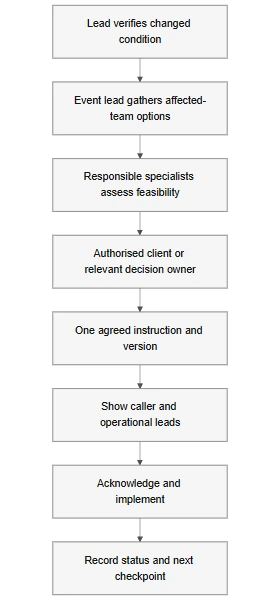
Planned response: hospitality provides a realistic status and next update time, including what is ready and what remains outstanding. The event lead coordinates with the venue, guest lead and show caller. The authorised client representative chooses an appropriate programme or guest-experience adjustment from options that are feasible. The show caller then issues the revised transition cue to the host and relevant teams.
Contingency: agree beforehand what can happen during a short hold, subject to the event's format and venue arrangements. That might be an approved networking interval in an available area or a revised transition sequence. Do not invent an extra performance or send guests to a different room without confirming staffing, access and hospitality implications. If an announcement is needed, keep it accurate and avoid a timing promise unsupported by the venue lead.
Intended outcome: guests receive a coordinated direction when the next space is ready. The planning record should show what delayed the handover and which update allowed the release. Thirty minutes is an example, not a standard buffer or an assurance that the programme can accommodate it.
Scenario: the entertainment rider arrives after production is finalised
Situation: an artist's requirements arrive after the equipment and schedule have been approved. Risk: new needs may affect the stage, rehearsal, technical scope, hospitality or access. A common failure is to forward the document to a supplier with 'please manage' while leaving the original price and timings unchanged.
Planned response: the production lead reviews technical requirements with the relevant specialists; the hospitality lead reviews their part; and the artist liaison confirms which requests are essential and who can approve an alternative. The event lead assembles one exception list showing the difference from the agreed scope, cost or timing effect, and decision deadline. The client approver decides with those consequences visible.
Contingency: discuss acceptable alternatives with the artist's authorised representative and record the agreement. Where a requirement cannot be met appropriately, the programme or performance may need revision. Do not substitute equipment or omit a material requirement solely on an informal assumption that the artist will accept it on arrival. Any safety-critical issue remains with the responsible specialists and venue.
Intended outcome: the artist and delivery teams share an agreed, feasible version of the performance plan. Update the production schedule and relevant cues, then confirm who has received the change. The preventive action is to make rider receipt and review a booking dependency, rather than discovering the requirements only after the scope is locked.
Turn the exercise into a short decision record
For each scenario, name the person who verifies the facts, the person who approves the programme choice and the person who distributes the instruction. Record what would trigger the fallback and when the next status is due. These are distinct responsibilities even if a small team combines some of them.
Use an approved host message where a disruption could require communication, but leave room for accurate facts. A template should not force someone to promise a five-minute recovery when the situation is unknown. Mark any untested alternative clearly so that it is not mistaken for a ready fallback.
The related presentation-change guide covers a new deck arriving minutes before stage. The guest-experience guide addresses simultaneous arrivals and registration; link its guest response into the opening cue rather than duplicating that team's procedures. After any exercise or real event, revise the contingency matrix with observed gaps and the owner of the next improvement.
Put the plan to work
Adapt these working tools to your event, venue and agreed responsibilities.
- Event contingency matrix