
Formats / THE EVENT OWNER’S VIEW
The Awards Night Playbook: Recognition, Running Order and Guest Flow
Plan categories, trophies, recipients, stage movement and hospitality as one coordinated recognition programme.
Decide what the recognition should mean
An awards night is a programme of recognition before it is a sequence of stage cues. Begin with the purpose: celebrating contribution, recognising a defined achievement, strengthening a community or marking an organisational milestone. Identify who is being recognised, who is watching and what the audience needs to understand about the award. The event team needs that context to shape a respectful and coherent experience.
The client awards owner is responsible for categories, eligibility, judging or selection arrangements and the approved results. The event team should not infer these from a draft list or make editorial decisions about who deserves recognition. Keep the governance of the awards distinct from the logistics of presenting them. Any rules or claims about the selection process must be supplied and approved by the responsible organisation.
The first gate is an approved recognition brief: purpose, audience, category structure, confidentiality requirements and decision owners. If there are commercial partners or presenters, clarify their roles without implying influence over results. Use Build an Event Brief That Makes Decisions Easier to record constraints. A strong production plan cannot repair an ambiguous award description once a recipient is walking on stage, so settle what is being recognised before designing how it appears.
Build a category architecture the audience can follow
Group the programme so guests understand where they are in the evening. Decide the order of categories, whether groups need introductions and where changes of pace belong. Ask what each category description adds and remove repeated language that explains the same point several times. A clear programme can still feel celebratory without making every presentation an extended segment.
Create a master awards register with category, approved title, recipient or result status, presenter, citation, pronunciation, trophy reference and intended screen content. Confidential information should be restricted to the people who need it through the agreed process. Avoid distributing a full results list simply because a supplier needs a category title.
The awards owner approves the register; the content owner maintains its released versions. Any change should trigger a review of script, graphics, trophies, seating or holding arrangements and running order. The architecture gate confirms the category sequence and what remains confidential or provisional. This matters before design because a new category may affect more than one slide. It can create another trophy, another presenter handover and a longer programme that changes dinner or transport timing.
Use an illustrative 90-day approval sequence
A 90-day window can help visualise dependencies, but it is not a prescribed lead time or a guarantee of feasibility. Award selection, procurement and recipient confirmation may follow a different calendar. Work backwards from the event and identify which decisions must be final before irreversible commitments are made.
Earlier in the example window, agree the recognition brief, category structure, audience and working budget. In the middle period, approve the programme concept, venue requirements, trophy specification and content workflow. As results and presenters become available, connect them to the master register, script and guest arrangements. During the final period, close artwork and name approvals, check trophies against the register and rehearse the presentation sequence with representative movements.
The awards owner controls result approval; the event lead coordinates the delivery schedule; the procurement owner confirms supplier commitments. Put a visible gate before trophy production or personalisation. If names are not ready, the team needs an agreed alternative, not an assumption that late changes will be possible. Record the consequence of missing each decision date. Use The Event Critical Path: What Can Delay an Entire Production? to connect the awards schedule to venue access, content checks and rehearsal rather than maintaining separate calendars that each expect another team to finish first.
Write the run-of-show around complete award cycles
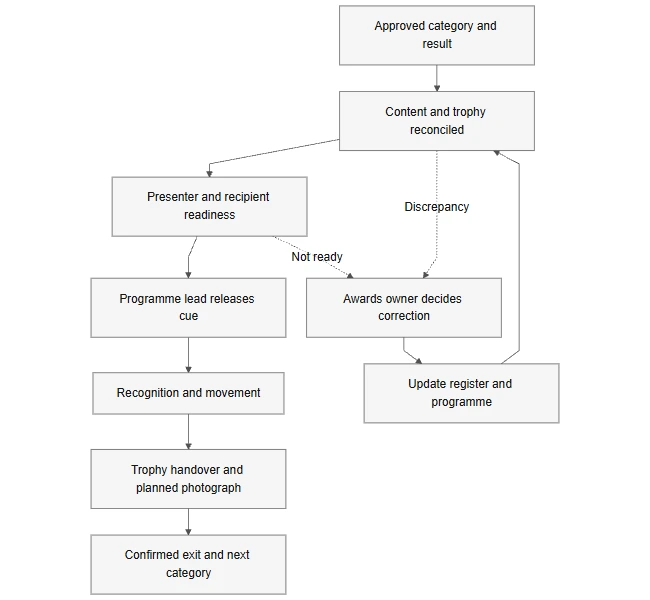
An award cycle includes introduction, citation or result, recipient movement, presentation, photograph where planned, applause and exit. The time is not only the host's spoken line. Map the complete sequence and identify where presenters, recipients and trophies enter and leave. Repeat this for different category formats rather than assuming every award follows the same pattern.
Give each cue a clear trigger and owner. The show caller or programme lead coordinates timing; the host uses the approved script; the awards desk controls the next trophy; the recipient liaison confirms readiness; the relevant operators follow the released cue plan. These are role responsibilities, not a staffing prescription. In a smaller event, combined roles must still allow the handovers to happen reliably.
The running-order gate checks that every category has an approved result status, presentable content and a workable cycle. Include transitions to entertainment, speeches and meals. Do not use an optimistic duration to make the evening fit, then expect recipients to move faster on the day. Rehearse representative cycles and use those observations to revise the programme. If the plan is too long, the client awards owner should choose an editorial change before the event, with its recognition implications made clear.
Plan stage movement at the guest level
The stage brief should explain who appears, how many people may be presented together, where the host and presenters stand and what recipients do afterwards. Ask whether anyone needs an alternative route or support and agree the arrangements privately with the relevant owner. The venue and appropriate specialists must assess the actual layout, access and technical requirements.
Think beyond the central photograph. Where does the next presenter wait? Can a recipient understand the exit route without crossing the next arrival? Where do trophies wait securely and how are they handed over? If group awards are included, the layout needs to accommodate the approved format rather than relying on an unplanned cluster. This guide does not prescribe stage dimensions, access gradients or safe capacities.
Walk the route in rehearsal from guest seating or holding through presentation and back to the audience. Use clear host instructions and a discreet liaison handover where appropriate. The layout gate requires a versioned plan, venue review and confirmation that the programme's movement is supported. Link How to Evaluate a Venue Before Signing the Contract for physical constraints and Production Planning: Screens, Lighting, Rehearsal and Reliable Content for the technical coordination interface. The event owner's job is to make the required experience explicit so specialists can assess it.
Treat trophies as controlled programme assets
Create a trophy register that connects each physical item to the approved category and recipient information. Include the artwork version, supplier status, checking owner, storage location and presentation order. Check spelling and any personalisation against the authorised source. A visually correct proof is not sufficient if the underlying name is still provisional.
Before dispatch or delivery, agree who checks quantity, condition and identification. On site, arrange storage and sequencing so the next item can be confirmed without opening every package. Keep presentation packaging, transport packaging and spare or unassigned items clearly distinguished. The awards desk owner should be able to identify the next trophy from the register, not from memory or an informal label.
Plan what happens if an item is damaged, missing or inconsistent with the approved information. The client awards owner chooses an acceptable presentation alternative, such as a clearly explained later handover, where appropriate. Do not conceal an error by presenting a personalised item to the wrong person. The trophy gate is a recorded reconciliation between approved register and available assets. Any unresolved exception must be visible to the programme lead before that category begins, because it may require a script or sequence change.
Coordinate recipients and presenters without spoiling the experience
Recipient handling depends on whether results are public, confidential or revealed during the event. An announced winner may be briefed directly; a surprise result requires a different readiness plan. The awards owner approves how confidentiality is maintained. The event team then plans seating, assistance and movement without distributing more information than each role needs.
For a holding area, define who belongs there, when they are called, who checks attendance and how they reach the stage. Do not fill a space with every possible recipient simply because it exists. Ask the venue to assess the arrangement and preserve necessary routes. If recipients remain seated until called, plan clear directions and allow for actual movement.
Presenter readiness needs its own confirmation: correct name, category, citation responsibilities, arrival and handover. A presenter should know whether to read, open an envelope, hand over a trophy or simply join a photograph. The liaison passes a concise ready or not-ready status to the programme lead. If a recipient is absent, use the approved proxy or later-collection approach rather than inviting an unverified person to improvise. The readiness gate connects the right people, the right trophy and the right content.
Make walk-up music and visual cues specific
A cue should identify the programme moment it supports and the conditions for starting and stopping. For walk-up music, define whether it begins after the name, during movement or at another agreed point. The relevant production specialists determine implementation. The programme lead should ensure that audio, host speech and recipient movement support the same sequence rather than competing for attention.
Use a cue register tied to category and version, including screen title, name, music reference where used and any photography hold. The client content owner approves names and visual wording; the relevant owner confirms that planned media use is appropriately cleared. Do not infer permission from a file being available online. This playbook does not offer legal clearance advice or prescribe technical settings.
Rehearse starts, stops and recovery when movement takes longer than expected. The operator should not need to guess whether applause means the recipient has reached the presentation point. Agree a clear trigger with the show caller or programme lead. The cue gate checks the approved media set, sequence and handovers. If a cue is unavailable, the fallback should preserve clear recognition and accurate naming rather than introducing unapproved music or graphics at the last moment.
Present 50 or more recipients without making a timing promise
Fifty or more recipients is a useful illustrative planning challenge, not a basis for guaranteeing an uninterrupted or delay-free show. First establish whether this means individual awards, group recognition or multiple recipients in some categories. Those structures create different movements and editorial choices. Count complete presentation cycles, not just names on a spreadsheet.
Rehearse representative cycles with realistic routes, handovers and photographs. The programme owner uses observations to test the total sequence, including category introductions and transitions. If the result does not fit the agreed evening, discuss options with the awards owner: shorter approved citations, grouped recognition where appropriate, different photography arrangements or a revised programme. Do not reduce a recipient's moment informally on the day simply because earlier segments overran.
Keep the next category prepared without crowding holding areas or confusing confidentiality. The trophy desk, recipient liaison and content owner should reconcile the next release before the cue. Establish a recovery choice for a missing presenter or absent recipient so uncertainty does not stop every role. The intended outcome is a controlled and respectful sequence, not an invented throughput target. Document the chosen structure and obtain approval before inviting guests to expect a particular recognition format.
Connect entertainment, dinner and recognition
Entertainment and hospitality are part of the same evening, with dependencies on the award sequence. Confirm where performance changeovers occur, how they affect the stage and whether guests are eating during recognition. A meal service can create movement and noise at a moment intended for attention, so the programme owner and banquet lead need to agree the relationship deliberately.
Record meal readiness, service changes and room transitions in the operating schedule. If the awards run late, the banquet lead should receive an early assessment rather than discover the change when service is due. The client programme approver decides which editorial adjustments are acceptable; venue and production leads confirm what can still be delivered.
Consider a hypothetical dinner delay. The risk is an unplanned gap or contradictory announcements. A common failure is for the host to invite guests to a receiving space before hospitality confirms readiness. The event lead establishes the revised timing, the programme owner selects an approved holding option and the guest lead communicates only the confirmed next step. The intended outcome is clear expectation and coordinated movement. See Networking, Attention and the Spaces Between Sessions for the conference-to-dinner handover and the operations scenario library for detailed programme recovery.
Test the plan at different audience scales
Audience examples of 100, 500, 1,000 and 5,000 are illustrative only. They are not approved venue capacities or instructions for staffing. The number of recipients and the award format may drive complexity as much as the total guest count, so assess both dimensions.
At a hypothetical 100-guest evening, the team might explore direct movement from tables while still checking sightlines and the presentation route. At 500, trophy sequencing, recipient identification and competing service movement may warrant more formal handovers. At 1,000, clear audience information and distinct support points may become important to evaluate. At 5,000, the team may need to consider audience zones, distributed communication and coordinated departure with venue and relevant specialist review.
Do not translate those observations into fixed desk or crew ratios. Ask how people will identify their next step and how the programme lead receives readiness information. If the event grows, revisit the approved layout, guest assistance, content visibility, hospitality and departure plan. The client should see those consequences before confirming an expanded invitation list. A larger audience cannot be accommodated solely by making the stage look larger; the complete guest and operating plan needs assessment.
Prepare for an incorrect name or missing award asset
Imagine a discrepancy between a screen name and the approved awards register during the final check. This is hypothetical. The risk is public misrecognition; the common failure is to let an operator choose between conflicting sources or to continue because the show is close. The authorised awards owner must establish the correct information.
The content owner traces the affected script, graphic and trophy. The programme lead assesses whether the category can proceed with approved corrected assets or whether the sequence needs adjustment. If a personalised trophy is wrong, a corrected slide does not resolve the whole issue. The client awards owner approves the presentation alternative and any explanation. Record the decision and distribute one released instruction.
If the discrepancy is discovered live, the host should receive an approved correction through the agreed route rather than inventing a reason. Protect the dignity of the recipient and avoid speculation about how the error occurred. After the event, assign the corrected asset or follow-up to an owner and reconcile the record. The intended outcome is an accurate, accountable response. The contingency plan should make that response possible without pretending every mistake can remain invisible.
Close with asset reconciliation and guest follow-up
The end of the programme is not the end of the awards work. Reconcile presented, uncollected, damaged and replacement trophies against the register. Assign each outstanding handover an owner and an agreed next action. Secure results and guest information according to the organisation's arrangements, and remove unnecessary working copies through the agreed process.
Before sharing photographs, names or citations, confirm the approved publication set with the responsible client owner. A stage appearance does not automatically settle every later use of an image or personal detail. Send promised information through the agreed communication route and keep the record of which version was released. The editorial priority is accuracy: recipient name, category, caption and accompanying claim should match the approved result.
Review the evening against its original recognition purpose and operational plan. Separate feedback about dignity and clarity from observations about timing, movement and service. A smooth sequence does not prove a wider organisational impact, while a long applause moment is not a reliable business metric. Capture decisions that would improve the next brief, such as a different category order or clearer presenter briefing. Link Make the Post-Event Review Useful for the Next Brief and Gifting and Post-Event Communication: Finish the Guest Promise for evidence and follow-up ownership.
Questions before the awards night is approved
Can all recipients wait beside the stage? Only if the actual space and operating plan support that approach. The venue and relevant leads must assess the arrangement. A holding strategy should be based on the programme and guest needs, not convenience for a single role.
How long should each award take? There is no universal answer. Test the complete cycle, including citation, movement, handover and planned photograph. Use those observations to make an approved programme choice rather than promising a fixed speed.
What if results are confidential until the announcement? Restrict the results register and agree exactly which roles need which information. Prepare the workflow with placeholders or controlled extracts, while retaining a reliable final release and reconciliation process.
What is the final approval pack? The recognition brief, approved register status, trophy reconciliation, script, cue plan, recipient and presenter arrangements, run-of-show, hospitality handovers and open exceptions. Confirm who can authorise a correction or programme change. Start with the awards-cycle worksheet before discussing isolated stage quotations, so the recognition experience defines the production requirement. For planning enquiries, contact hello@threesixzero.live.
Put the plan to work
Adapt these working tools to your event, venue and agreed responsibilities.
- Event brief and approval worksheet
- Format and programme worksheet