Formats / THE EVENT OWNER’S VIEW
The Product Launch Playbook: From Announcement to Guest Understanding
Plan the message, reveal, demonstration and follow-up as one launch experience, with clear decisions before production begins.
Start with the decision the launch should support
A launch is a moment in a product's story, not the whole commercial plan. Before discussing a reveal, ask what the audience should understand or be able to do afterwards. The answer may be to explain a new offer, evaluate a demonstration, brief customers, request a conversation or prepare a sales team. These are different purposes. A dramatic reveal might support one of them, but it cannot substitute for a clear explanation.
Write a primary objective and describe the evidence that would help assess it. If understanding is the purpose, a relevant question or short feedback prompt may be more useful than the number of photographs taken. If conversations are the purpose, specify who will receive requests and what happens next. Do not promise sales results that the event team cannot control.
Name the business owner who approves the launch objective and the product owner who confirms what can be said. The planning lead then converts that brief into programme, guest and production requirements. The first approval gate is a short written agreement on audience, purpose, announcement scope and constraints. If these remain disputed, a venue booking or scenic concept will tend to settle the format by accident.
Choose the audience and format together
A mixed guest list can contain people with different reasons to attend. A customer may want to see the product used; a distributor may need commercial clarity; an internal colleague may need language for future conversations. Record these needs without assuming that one presentation answers all of them. Decide whether the programme needs a shared introduction followed by different demonstrations, discussions or hosted areas.
Choose the format after identifying those needs. A seated presentation creates shared attention but limits individual interaction. An open demonstration format gives guests more choice but needs a clear orientation and a way to manage concentrated demand. A press briefing and a customer experience may need different content approvals and guest handling. Combining them is a decision to design carefully, not an automatic economy.
The client audience owner approves guest categories and invitation priorities. The programme owner tests whether every category has a useful reason to be there. The venue and guest leads review whether the proposed flow can work in the available space. Record any trade-off: for example, fewer simultaneous activities in exchange for more guided explanation. The format gate is passed when the team can describe a credible journey for each principal audience, including what they do after the announcement.
Build the message before designing the reveal
Create a message sheet that separates the central announcement from supporting details. It should identify what is new, who it is for, what guests should understand and which statements need approval. Keep product claims, availability, pricing and comparative language with the authorised product or commercial approver. An event script should not become the place where unresolved product decisions are improvised.
Build a content register covering invitations, host script, presentation, demonstration commentary, screens, printed information and follow-up. Each item needs an owner, approver, version and intended use. If a statement changes, the content owner traces all affected items rather than replacing only the keynote slide. Agree who may release information publicly and when; do not assume that attendance gives every guest the same publication permissions.
Design the reveal around the approved message. Ask what the audience needs to see, hear and understand immediately afterwards. A reveal that ends in applause but leaves the product unexplained has not completed the communication task. The content gate therefore includes the transition from announcement into explanation, not just the reveal cue. For a deeper file-control discussion, connect this plan with The CEO Changes Their Presentation Five Minutes Before Stage. That guide addresses late replacements without treating a previous version as acceptable when its message has become incorrect.
Distinguish a launch from a brand activation and plan media moments
A product launch centres on an introduction or announcement. A brand activation, as used here, centres on an audience interaction with the brand; it may support an existing offer without announcing something new. The labels are planning distinctions, not fixed industry rules. A launch can include activation-style experiences, but the brief should say whether the priority is understanding the new offer, participation or another objective. That decision changes the programme and the next step for guests.
Plan media moments as part of the approved communication. Identify what can be photographed or recorded, the intended view of the product and who approves spokesperson statements. If interviews or product photography are part of the scope, allocate a practical place and time with the venue and programme leads. Do not promise press coverage or treat an invited journalist as an endorsement.
The client communications owner approves the media brief, announcement timing and release materials. The guest lead handles confirmed media attendance, while production and venue leads assess the physical arrangements. Keep media movement from obstructing other guests' planned experience. The approval gate connects the message, access and programme so the photographable moment does not displace the explanation guests came to hear.
Use a 90-day example as a dependency map
The following 90-day planning window is illustrative, not a minimum lead time or a promise that every launch fits it. Product readiness, procurement, venue access and approvals may require a different period. Its value is in showing the order of decisions and what each decision releases.
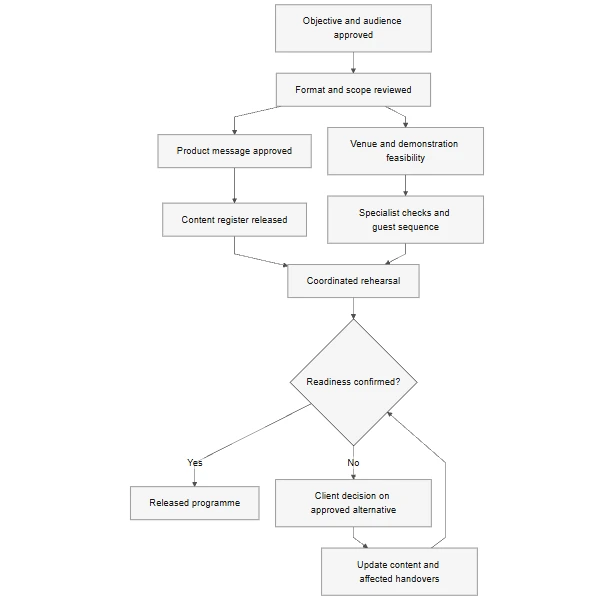
Around days 90 to 61 before the event, agree the objective, audience, product status and budget range. Test venue and format options against demonstrations, guest movement and access. Around days 60 to 31, approve the working concept, proposed scope and announcement responsibilities; begin invitation planning and detail the demonstration requirements. Around days 30 to 15, bring the programme, guest information, layouts and content into coordinated versions, with unresolved items assigned. During the final fortnight, close approvals, rehearse representative handovers and confirm the delivery and guest communication plans.
The event lead owns the integrated schedule. Product readiness is an input owned by the product team, not an assumption the event agency can approve. If a product or claim is delayed, the sponsor chooses whether to change the promise, format or date. Mark those decisions as gates with consequences. See The Event Critical Path: What Can Delay an Entire Production? for how one unresolved dependency can move the readiness decision even while other work appears on schedule.
Specify demonstrations as guest experiences
For each demonstration, describe the question it answers, the interaction it permits and the support it needs. Is a guest watching, trying, comparing or asking an expert? Write the beginning and end of the experience, including how the next guest is welcomed. A demonstration can fail editorially even when the product functions: the host may explain too much, the audience may not see the important detail, or there may be no clear next step.
The product lead confirms representative units, approved behaviour, presenters and any restrictions. Relevant specialists determine technical and safety requirements. The event lead coordinates the space, schedule, guest interface and dependencies; this playbook does not prescribe power, equipment or protective measures. Record setup, checks, replenishment where relevant, cleaning or reset needs, storage and the owner of a stop decision.
Prepare an alternative that is truthful. An approved recording, explanation or static display may be appropriate if a live demonstration becomes unavailable, but it must be clearly presented for what it is. Do not describe recorded footage as a live result. The demonstration gate requires product approval, a workable guest sequence and confirmation from responsible specialists that the proposed use is ready. The host should know both the normal explanation and the approved alternative.
Evaluate the venue against the whole launch
A launch venue must accommodate more than the audience facing a stage. Map preparation, hidden product holding where needed, demonstration areas, presentation positions, circulation, guest assistance and the departure journey. If there are media conversations or private meetings, identify where they happen without consuming routes needed by everyone else. Ask which areas are shared with other functions and when they become available.
Walk through the event from an early guest's arrival to the final collection or handover. What can they see before the intended announcement? Where will they wait if the room is not ready? Can the programme move from a seated moment to an interactive one without guests converging on a single point? The venue lead and production lead should test the actual layout rather than treating a published room capacity as proof of feasibility.
Confirm access, storage, service movement, installation and removal conditions in writing. The venue booking approver should see unresolved conditions that affect the concept before committing. A design dependent on concealed loading or a room reset is not ready merely because the room looks suitable. Use How to Evaluate a Venue Before Signing the Contract to maintain a marked plan, written access assumptions and an exceptions list. These documents provide the basis for a decision; they do not replace venue or specialist approval.
Connect invitations, RSVP and commercial handover
The invitation should make the event's purpose and practical requirements clear without making an unapproved announcement. Decide which details are public, which are for confirmed guests and which will be introduced on the day. Provide a useful response route, a way to ask questions and a named owner for guest-list changes. Avoid creating several unmanaged lists for different stakeholder teams.
Capture only information needed for the agreed guest arrangements and follow-up. Confirm who manages it and who can access it. Where guests request access, dietary or travel support, share the necessary action with the relevant owner through the agreed process. This is an operating decision to confirm with the organisation's privacy owner, not a reason to collect every possible preference in a form.
Plan the handover from attendance to next conversation before invitations are issued. A guest asking for a demonstration follow-up needs an owner and a clear route, rather than a stack of unassigned enquiries after the event. The client commercial lead approves what follow-up is appropriate. Invitation approval includes accurate timings, address, response instructions and the intended use of responses. Related practical guidance sits at From Invitation to Registration: Plan the Arrival Before the Queue and Gifting and Post-Event Communication: Finish the Guest Promise.
Rehearse the transition, not only the reveal
Build a run-of-show that names the owner and cue for each programme change. The product lead controls the approved explanation; the content approver controls statements; the show caller or programme lead coordinates timing; the guest lead manages where people move. These are responsibilities, not a prescribed headcount. A smaller team may combine roles provided it can still perform the necessary handovers.
Rehearse the path from host introduction to announcement, reveal, explanation and guest activity. Check when presenters move, when the audience is invited to participate and what the hospitality team does during the transition. A cue that looks clear on paper may conflict with movement through the same area. Resolve these conflicts while there is still a choice about the sequence.
Agree what constitutes readiness for the actual programme. Required checks belong to the relevant specialists, while the client approver confirms the content remains accurate. Do not spend all rehearsal time on the most theatrical moment and leave the closing instructions untested. The rehearsal record should identify exceptions, decisions and owners. A missed item should be visible at the readiness gate, not hidden by a general statement that rehearsal happened. Link the guest movement plan with Design the Event Around the Guest Journey.
Compare scale without prescribing capacity or staffing
Guest counts of 100, 500, 1,000 and 5,000 are illustrative planning scenarios, not validated room capacities or staffing recommendations. At any scale, feasibility depends on the layout, arrival pattern, programme, service needs and venue requirements. The useful comparison is which decisions become more connected as the audience changes.
For a hypothetical 100-guest launch, a shared presentation and hosted product conversation may be considered, with attention to whether everyone can engage. At 500, the team may need to test whether demonstrations concentrate demand after the same announcement. At 1,000, distinct arrival groups, repeated experiences or clearer audience zoning may deserve evaluation. At 5,000, the planning discussion may involve multiple audience zones and coordinated arrival and departure arrangements, with venue and appropriate specialists assessing the operating plan.
None of these examples implies that a particular format or number of desks is sufficient. Ask the guest lead to model likely demand, the venue to assess the layout and the programme lead to test timing. If the count changes, revisit more than catering. Content visibility, access, guest support, demonstration availability and follow-up ownership may all change. Record the revised assumptions and obtain approval before treating the larger invitation list as a minor edit.
Plan for a product or speaker arriving late
Consider a hypothetical launch where a demonstration unit is delayed while guests are already travelling. The risk is that the programme promises an experience that is no longer ready. A common failure is to let each team invent its own explanation while the host continues to work from the original script. The intended outcome is a truthful, coherent programme, not an attempt to conceal the change.
The product lead establishes what is actually available and when. The event lead maps the consequence for setup, checks and guest flow. The authorised client approver chooses among viable alternatives, such as an approved recorded explanation, a revised session sequence or a narrower demonstration. The content owner then updates the relevant script and visuals, and the programme lead issues one confirmed instruction.
Set a decision checkpoint before the affected moment. If readiness cannot be established by then, use the approved alternative rather than extending uncertainty into the introduction. Apply the same logic to a late speaker: determine whether a different session order is feasible, brief affected leads and tell guests what they need to know. The contingency must respect the remaining programme and approvals. It is not permission to compress essential checks or claim that an unavailable experience took place.
Keep the launch control pack small enough to use
A control pack is useful when each document answers a decision question. The brief explains why the event exists. The scope and budget identify what has been approved. The content register states what may be shown. The guest plan explains how people arrive, participate and leave. The run-of-show coordinates the programme. Give each record a version, owner and place in the shared working folder so that a revised attachment does not become an unofficial instruction.
Before the final readiness meeting, ask each lead to submit exceptions rather than a long account of completed tasks. An exception should name the unresolved fact, its consequence, the decision needed and the latest useful decision time. The event lead consolidates related exceptions, because a late product change may affect several documents at once. The client approver then receives choices with consequences instead of disconnected requests.
After approval, distribute the relevant extracts to the people doing the work. A guest host does not need confidential product planning material to know the registration route. A presenter does need the current message and sequence. This controlled distribution makes the pack operational without treating every participant as an approver.
Close the event with a useful next step
The closing moment should answer what guests can do next and where they can obtain approved information. Decide whether that means arranging a conversation, revisiting a demonstration, receiving a resource or simply leaving with a clearer understanding. Do not combine every possible request into a final slide. A focused next step is easier for the guest and easier for the client team to own.
Prepare the post-event communication alongside the content register. Confirm which presentation, product details and images may be shared and with whom. If information changes after the event, the product owner approves the update before distribution. Separate promised materials from general promotional activity, and use the organisation's agreed permissions and communication practices.
The review should distinguish attendance, engagement observations and commercial outcomes. A busy demonstration area may show interest but does not prove understanding or conversion. Compare the evidence with the original objective and record its limits. Assign unanswered guest questions, requested conversations and outstanding assets to named owners. Keep operational learning specific enough to improve the next brief. Use Make the Post-Event Review Useful for the Next Brief for an evidence register that separates confirmed facts, interpretations and decisions instead of turning the launch into an unsupported success claim.
Questions to settle before approval
Does every launch need a large reveal? No. Choose a reveal only when it supports the message and can be delivered within the agreed constraints. A clear demonstration or focused conversation may serve a different objective better. The format should earn its place in the brief.
Can the invitation go out before all content is finished? Some content can develop later, but the invitation's claims, date, location and guest expectations need approval. Identify which unresolved decision could make those statements wrong before releasing them. Do not treat a save-the-date as permission to imply an unconfirmed experience.
What if the product changes late? Route the change through the product approver, content owner and event lead. Trace its effect on demonstration, programme, guest communication and follow-up. A revised slide is not necessarily the whole change.
What should be in the final approval pack? Include the agreed brief, current scope and budget, venue conditions, guest plan, message and content register, demonstration readiness record, run-of-show, named decision owners and alternatives. Keep open items visible. To begin, draft the objective and the guest's next step using the event-brief worksheet, then discuss the dependencies with your planning partner. ThreeSixZero enquiries: hello@threesixzero.live.
Put the plan to work
Adapt these working tools to your event, venue and agreed responsibilities.
- Event brief and approval worksheet
- Format and programme worksheet