Formats / THE EVENT OWNER’S VIEW
Town Halls and Hybrid Q&A: Plan for Employees in Every Audience
Define the communication purpose, participation format and question workflow before choosing the room or platform.
Choose the employee communication purpose
A town hall can explain a decision, share context, discuss priorities or create a route for employee questions. Decide which purpose leads. If a decision is already made, describe the session honestly rather than presenting it as open consultation. If input is being requested, explain what is still open and how responses will be used.
The client communications or employee-engagement owner approves the purpose, audience and sensitive-topic boundaries. The programme owner shapes the session. The event lead connects it to the room, remote participation and production brief. Do not let the availability of a platform poll determine the engagement objective.
The brief gate records what employees should understand, what they can influence and what follow-up is promised. Use Build an Event Brief That Makes Decisions Easier to separate that objective from the choice of a town hall, panel or workshop. An engaging format is useful only when it supports an accurate message and a credible response process.
Choose participation formats with a clear output
A leadership update, moderated conversation, small-group discussion and live question session ask different things of employees. Give each format a purpose, instructions and an output owner. A discussion that gathers concerns needs a route to the people who can respond; a poll needs a reason to influence the conversation rather than act as decoration.
Consider employees joining from different locations, work patterns or access circumstances. The client owner decides how participation is offered and what alternative information route is needed. Avoid assuming that attendance at one live moment is possible for everyone.
The programme gate checks the balance between explanation and participation. Do not promise to answer every question if the agenda cannot support that claim. Instead, set expectations about selection, grouping and appropriate follow-up. Link Networking, Attention and the Spaces Between Sessions for programme rhythm and Make the Post-Event Review Useful for the Next Brief for assessing usefulness without turning participation counts into a claim of trust or engagement.
Write a production brief for both audiences
For a hybrid town hall, describe what in-room and remote participants need to see, hear and do. Include presenters, slides, videos, audience questions, remote contributions and any intended recording. Explain which interactions are essential to the objective and which are optional. The production team can then assess the actual requirements rather than infer them from the word hybrid.
Ask the relevant specialists to propose the platform, connectivity, presentation and support arrangements and to explain the checks and alternatives. This guide does not prescribe bandwidth, equipment or platform settings. Current platform capabilities and organisational requirements must be verified for the selected setup.
The client content owner approves what may be shared and recorded through the organisation's process. The technical readiness gate is separate from content approval. A working connection does not establish that the message is approved, and an approved slide deck does not establish that remote guests can follow it. Keep both statuses visible.
Make remote participation part of the programme
A remote audience needs deliberate orientation. Explain when questions are taken, how to submit them and what happens if a connection is interrupted. The host should recognise the remote audience in the programme rather than speak only to the room and assume the stream carries the same experience.
Assign an owner to monitor the remote participation route and feed relevant information to the moderator or programme lead. Define how a remote speaker is introduced, checked and handed over. Do not ask the moderator to discover technical or access problems while also managing the conversation.
Rehearse representative interactions using the intended setup. Include a question from each audience and a transition between a presentation and discussion. Relevant specialists determine the required technical checks. The programme owner tests whether the interaction remains clear and useful. The readiness gate confirms both the functioning route and the human handovers.
Build a Q&A workflow before collecting questions
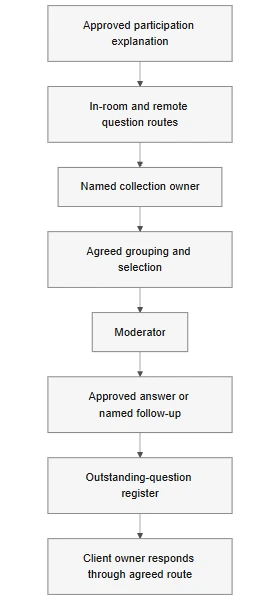
Define how questions enter, who reviews them, how they reach the moderator and who owns unanswered items. Explain the method to employees in clear language. If questions are grouped or selected, say so; do not imply that submission guarantees an on-stage answer.
Agree the editorial criteria with the authorised client owner. Questions may need to be combined because they address the same issue, or routed privately because they concern an individual matter. Keep that distinction from becoming an unspoken process. The moderator should know which answers are approved, which require a named owner and when it is appropriate to say the answer is not yet available.
Do not make unsupported promises about anonymity or privacy. Confirm what the selected process actually records with the organisation's responsible owners before describing it to participants. The question gate approves the guest-facing explanation, internal workflow and follow-up ownership. Technology provides a channel; people remain responsible for the editorial decisions and responses.
Prepare leaders and moderators for uncertainty
Brief speakers on the audience, purpose, format, timing and question process. Ask them to distinguish confirmed information from decisions still under review. A clear acknowledgement that an answer is pending is more credible than an improvised commitment that the organisation cannot honour.
The moderator needs a route to the client decision owner for sensitive or unresolved topics. Agree how to pause, clarify or assign follow-up without turning the session into a sequence of evasions. Prepare a closing summary that states what was covered and what happens to outstanding questions.
The content gate includes the main messages and the handling of uncertainty. It should not attempt to script every possible conversation, but it should identify who can approve a new commitment. Connect late presentation changes to The CEO Changes Their Presentation Five Minutes Before Stage so a revised leadership message reaches the production and programme teams through one controlled route.
Scenario: the remote audience loses the intended interaction
Imagine the remote question route becoming unavailable during the town hall. This is hypothetical. The risk is that the programme continues to promise participation that some employees cannot access. A common failure is to ask remote guests to keep trying while the moderator assumes questions have stopped.
The remote support owner establishes the issue and informs the programme lead. Relevant technical specialists assess recovery. The client and programme owners choose an approved alternative, such as a confirmed later question route or a revised interaction, and the host communicates what is actually available.
Do not promise an immediate repair or introduce an unassessed public tool to recover the moment. The contingency should be agreed before the event and respect the organisation's information arrangements. The intended outcome is honest participation guidance and a visible follow-up commitment. Record the interruption when reviewing feedback so a low question count is not interpreted as a lack of employee interest.
Close the loop on questions and resources
Assign outstanding questions to the responsible client owners and agree how employees will receive updates. Keep the wording and context clear enough that an answer addresses the original issue. A list of questions is not closure until the agreed response process has a status and an owner.
Confirm the approved recording or resource version before sharing it. Remove or handle content according to the organisation's approved process rather than assuming everything said live is automatically cleared for wider distribution. Tell employees where to find the confirmed material and how to raise a remaining question.
Review the session against the communication objective. Attendance and question counts can describe activity but do not by themselves prove understanding, confidence or trust. Use Make the Post-Event Review Useful for the Next Brief to separate evidence, interpretation and next actions. The review gate should identify what the next employee communication needs to address.
Questions for the town-hall owner
Must a hybrid event reproduce every in-room interaction? Decide what participation is essential and design a credible route for each audience. Be explicit about differences rather than assuming a broadcast is equivalent to participation.
Should questions be collected in advance? They can inform preparation, but agree whether and how live questions also enter the programme. Explain the process clearly.
Can every answer be immediate? No. Name the owner and follow-up route for unresolved questions instead of creating an unapproved commitment.
Use the town-hall and Q&A worksheet to brief the programme and production teams together. For planning enquiries, contact hello@threesixzero.live.
Put the plan to work
Adapt these working tools to your event, venue and agreed responsibilities.
- Town-hall and Q&A worksheet