
Strategy / THE EVENT OWNER’S VIEW
The Corporate Event Budgeting Playbook
Build a budget that explains what the event will deliver, which assumptions could change and who can approve the consequences.
Budget the event before buying its parts
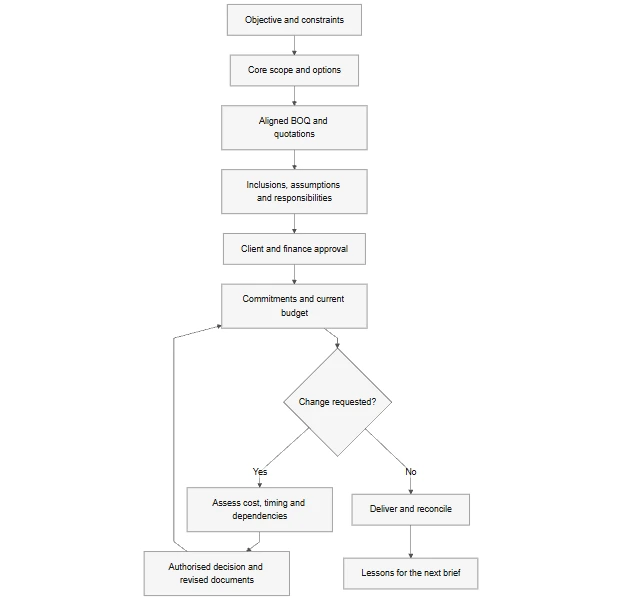
An event budget is a decision document before it is a price list. It should connect the business objective to a feasible format, then explain the resources required to deliver that format. If quotations arrive before the brief is aligned, the cheapest set of assumptions can become the plan by accident.
Begin with the audience, desired outcome, dates, venue status, programme and guest journey. Identify what is fixed and what can change. A leadership conference with accommodation has a different cost structure from an evening launch, even if both serve the same number of guests. Give the event lead a working budget boundary and the priorities that must survive any reduction.
The first deliverable is a budget brief, not an equipment shopping list. Record the client approver, finance contact and scope owner. State whether the working ceiling includes all expected charges and which items may be funded elsewhere. This prevents separate departments from assuming that someone else has allowed for hospitality, travel or post-event work.
Define the minimum viable experience
List the outcomes the event must support and the moments that carry them. If the purpose is a product demonstration, visibility, clarity and a workable demonstration sequence are central. If the purpose is conversation among partners, the programme and room arrangement need to support that interaction. Decide what the audience must receive before choosing decorative scale.
Ask the team to describe a core scope and a small number of meaningful enhancements. Each option should state the guest benefit, delivery implications and dependencies. More expensive is not automatically more effective; cheaper is not automatically a prudent saving. The test is whether the choice supports the event's objective within the agreed constraints.
Record protected requirements in plain language. These are not a reason to invent technical specifications: the responsible specialists must define and approve those. They are a way for the client to make trade-offs consistently when proposals evolve. A written priority is easier to defend than a preference discovered after suppliers have been booked.
Build a cost structure that follows the whole lifecycle
Group the budget around the work: planning and creative, venue, production, guest services, hospitality, logistics, event operations and post-event deliverables. Then break each group into items that can be described and assigned. This structure exposes gaps between departments while keeping the document readable for the client.
Include preparation and closure. Content development, site visits, rehearsal support, delivery, removal and final reporting may not be visible during the programme, but they still need an owner. Avoid treating the show itself as the only paid period. Ask whether each quoted service covers the hours and stages needed by the schedule.
Create one master budget with links or references to supporting quotations. Keep the approved total separate from the latest estimate and committed orders. Those figures answer different questions. The client needs to know both what has been authorised and what the current plan is expected to cost if its unresolved assumptions are confirmed.
Use a BOQ to compare equivalent scope
A bill of quantities should connect each quoted item to a deliverable. Record description, quantity or basis, duration, unit price where relevant, total, inclusions, exclusions, assumptions and responsible supplier. Add a reference to the programme or layout version on which the estimate depends. Technical descriptions can support the document without replacing an explanation of purpose.
For each agency, map the response into the same comparison structure. Do not force different creative concepts into false equivalence; identify where the proposed experience differs and ask the client to judge that difference. Within comparable scope, request clarification wherever a bundled line prevents assessment of service or responsibility.
The comparison is complete only when missing items are resolved. A blank price can mean included elsewhere, excluded, not applicable or not yet assessed. Give those states different labels. Otherwise a lower total may simply be an incomplete response being compared with a more developed plan.
Distinguish fixed, variable and step-change costs
Some costs are largely driven by the chosen scope, while others follow the number of guests or the duration. Label these differences. Meals and guest materials may have an attendance basis; a creative concept or stage design may be linked more closely to the format. Ask suppliers to state the basis rather than assuming it from the item name.
Also identify points where the operating plan changes. Additional guests may require a different room arrangement, more service provision or revised transport movements. This is a step change, not just another multiplication of the original per-person figure. The relevant threshold comes from the proposed plan and provider confirmation, not a universal rule.
Prepare a small set of clearly defined scenarios if attendance is uncertain. Record what changes operationally as well as financially. This gives the client a useful choice and prevents a later increase from appearing unexpectedly as several unrelated additions. Update those scenarios as registration information becomes firmer.
Test venue choice against the total event cost
A venue price is one component of a venue decision. Compare the total plan supported by each option: access, production, furniture, hospitality, guest travel, accommodation where relevant, and additional operating spaces. A lower room charge may coincide with a shorter preparation window or a layout that requires a different production approach. Confirm the actual conditions before drawing a conclusion.
Use the same brief for each venue and ask the event lead to record consequential changes. If one venue includes usable furniture and another requires external provision, show that in the comparison. If an inclusion does not meet the brief, do not count it as a saving solely because it appears in the package.
Bring the venue recce findings into the budget. Loading conditions, service routes and room transitions may affect the proposed work sequence. The client should approve the venue and event scope together, with open commercial questions recorded, instead of discovering the full cost after the booking has removed alternatives.
Explain the agency fee and delivery responsibility
Ask the agency to explain how planning and management are priced and what those services include. Creative development, supplier coordination, client meetings, budget control and event-day oversight should have a defined scope. Clarify the process for work outside that scope and how any additional fee is approved.
Production costs and management services answer different questions. An equipment or fabrication quotation does not by itself describe who integrates the programme, guest flow and supplier dependencies. Conversely, a management fee does not establish that every production requirement is included. Read both alongside the responsibility matrix.
Compare the commercial models openly. The client needs to understand what is being purchased and who remains accountable, without assuming that one fee structure is always superior. Ask for the proposed team roles, decision process and deliverables. This makes the comparison about a service the agency has committed to provide rather than a percentage detached from scope.
Find hidden costs by finding hidden assumptions
The most useful question is not what unexpected extras might exist in theory. It is what the current estimate assumes someone else will provide. Review access, overtime, rehearsal, delivery and collection, content revisions, crew meals, temporary storage, internet and venue-specific requirements where they apply. Assign each requirement or mark it explicitly not applicable.
Review guest-related deadlines with the hospitality and finance leads. Final numbers, room allocations or programme changes can have commercial consequences under the agreed terms. Ask the responsible provider to explain those terms in the context of the event and record the decision dates in the planning schedule.
For a hotel package, compare the banquet order with the agency budget. Resolve duplicate provision and missing responsibility. Request written clarification of any package language too broad to use as an approval basis. A complete scope is more useful than a long exclusions page that leaves the client to discover which exclusions matter.
Control the programme because it controls the budget
A programme change can alter several workstreams at once. An additional award sequence may affect scripting, graphics, music cues, rehearsal, trophies and hospitality timing. A remote speaker may introduce requirements that were not part of an in-room presentation brief. Treat the programme as a commercial input, not only an editorial document.
Set a process for proposed changes. The requester states the purpose; the event lead identifies affected owners; the relevant teams assess cost and feasibility; the authorised client approves the revised scope. Record whether the change replaces something or adds to it. This avoids paying for an abandoned element because cancellation was never communicated.
Keep the change log connected to the master budget and schedule. A change is not closed when someone agrees verbally that it sounds good. It is closed when the decision, price, responsibilities and revised documents are consistent and the affected people have received the instruction.
Make contingency specific and controlled
A contingency allowance should reflect unresolved conditions and have an approval process. Describe the risks it is intended to address, the potential decisions and the person authorised to release funds. Do not treat it as a hidden enhancement budget or a substitute for developing the scope.
Ask what would reduce the uncertainty. A completed recce, confirmed speaker requirements or a settled guest count can remove ambiguity more effectively than carrying a vague reserve. Distinguish a response to changed conditions from a discretionary improvement that belongs in a separate option.
As the event approaches, review the risk list and remaining allowance together. Record approved use and avoid counting the same provision both in a supplier estimate and in contingency. The client should be able to see what remains available and what exposure remains open, without relying on an unexplained percentage presented as standard for every event.
Reduce cost through deliberate redesign
When the estimate exceeds the boundary, return to the objective and protected requirements. Ask for changes that simplify the plan: fewer room transitions, a more focused programme, reusable content treatments or a less elaborate build, where these suit the brief. Each proposal needs a clear description of what the audience and delivery team will experience differently.
Do not ask a supplier to remove an item without understanding its purpose. A line that appears invisible to guests may support coordination, testing or safe delivery. Ask the responsible lead to identify consequences and approve a feasible alternative. Commercial pressure does not replace technical or safety judgment.
Compare reductions as complete options rather than accumulating small cuts across unrelated departments. Several individually modest changes can create a less coherent event. The client should sign off a revised experience and delivery plan, with the new total and dependencies visible, instead of approving only a target discount.
Plan commitments and cash flow
Build a payment schedule from the agreed supplier terms and approval milestones. Identify when commitments become binding, what information is required before an order and what the client must approve for payment to proceed. Have the authorised commercial and finance teams review contract terms and the implications of postponement or cancellation.
Keep quotation validity and availability assumptions visible. If a decision is delayed, ask the supplier to reconfirm before treating the old estimate as current. Do not assume that a previous proposal reserves stock, crew or a venue date. Record the actual commitment status for each major item.
The event lead should coordinate timing so procurement does not become a surprise constraint on production. Share realistic approval dates with the client and identify the consequence of missing them. This is a planning conversation: it allows the client to act before a deadline forces a more expensive or less suitable alternative.
Keep tax treatment separate from optimistic savings
Ask finance to review the proposed supplier and recipient details, nature of supply, invoice treatment and any expected tax recovery. This guide does not provide a rate card or a conclusion about a particular event's input tax credit. The event budget should show the provider's tax treatment clearly and record unresolved questions for the appropriate adviser.
Do not reduce the working cash requirement by an assumed recovery that finance has not confirmed. Keep the amount payable, any finance-approved accounting treatment and the timing of payments distinguishable. That gives the client a usable approval figure while technical tax questions are resolved by the right owner.
Use the separate GST planning checklist for the questions and source trail to take into that discussion. Tax analysis depends on the actual arrangement and current rules, so changing how a service is contracted or invoiced should trigger a fresh review rather than copying a conclusion from a previous event.
Illustrative scenario: the lowest quote is incomplete
Imagine two proposals for the same conference. The lower total lists production for the programme period, while the other explicitly includes rehearsal support, installation and removal. The risk is approving an apparent saving before discovering that the missing stages still need to be purchased. This example illustrates a comparison problem; it does not imply any particular supplier practice.
The event lead maps both proposals to the shared BOQ and asks each agency to confirm the missing scope and terms. Finance compares the revised totals and commitments. The client then assesses the complete solutions, including responsibility for handovers, rather than defending the first headline number received.
If the developed price exceeds the boundary, the contingency is a deliberate scope revision before commitment. It is not an assumption that essential work will somehow be absorbed. The intended outcome is an informed purchase with fewer unresolved commercial gaps, not a promise that the initially higher proposal will always be the better choice.
Three questions before approving the total
Is this a complete budget or an early estimate? Ask the owner to identify provisional lines, missing confirmations and the date of the next review. An early estimate can support a decision, provided its uncertainty is visible.
Can two quotations be compared if their concepts differ? Compare the common requirements first, then assess the differences as explicit experience choices. Do not force a creative distinction into a price comparison that suggests the scopes are identical.
What if the budget boundary changes after approval? Ask for a revised plan and commitment review before promising a reduction. Some choices may still be open while others have already created obligations under agreed terms. The authorised commercial owner should establish those facts. The useful response is a current decision set, showing what can change, its consequences and the new approval required.
Keep a supplier commitment register alongside the approved budget. A quote, an approved purchase and a paid invoice are different stages of the same cost, not three separate costs to add together. Record the latest approved amount, committed amount, payment made and balance expected for each scope item. At each review, reconcile the register with the change log and ask the relevant owner to explain differences. This makes a pending approval visible before it becomes a payment deadline and reduces double counting when revised quotations arrive.
Close the account and improve the next brief
After the event, reconcile the final account against approved scope and changes. Request the supporting detail needed to resolve differences and assign outstanding actions. Separate a disputed addition from an agreed variation that has not yet reached the master record. Use the approved documents as the basis for discussion.
Review where estimates moved and why. Was the brief incomplete, attendance uncertain, a venue condition discovered late or a client change approved after production started? Capture the decision that would have improved predictability. Do not turn the debrief into a generic statement that costs should be controlled more carefully next time.
The final budget pack should contain the approved brief, BOQ, comparison notes, commitments, change log and reconciliation. For a new event, share your objective, audience range, date and venue status with ThreeSixZero. A useful commercial conversation starts with those decisions and develops the event as a whole before separate quotations become the only definition of scope.
Put the plan to work
Adapt these working tools to your event, venue and agreed responsibilities.
- BOQ and quotation comparison worksheet
- Scope change and approval log