
Venue / THE EVENT OWNER’S VIEW
The Five-Star Hotel Event Playbook
Plan the hotel event as one operating system: room design, access, service, production and commercial commitments must work together before the ballroom is booked.
A hotel booking is an operating decision
A five-star hotel can offer accommodation, meeting rooms and hospitality within one property. That convenience is valuable only when the event plan fits how the property operates. The ballroom may share a foyer with another function. The route for equipment may also serve the kitchen. The room may be available for the programme long before it is available for installation. These are questions to investigate, not assumptions to make from the category of hotel.
Start by defining the business event: what the audience needs to understand or do, which moments matter and how the day should flow. Then test the property against that brief. A venue can be beautifully presented and still be unsuitable for a product reveal, a complex awards sequence or a conference that must become a dinner within a short interval.
The booking decision should bring together the client owner, event lead, hotel representative and relevant production specialists. Their first output is a feasibility record: what fits, what depends on confirmation and what would need to change. Use this playbook to organise those conversations before separate suppliers start making incompatible promises.
Translate the brief into a space schedule
List the spaces the event needs, including those guests will never see. Alongside the main room, consider arrival, registration, guest queries, speaker preparation, temporary storage, crew coordination, meals, dressing or holding areas and any breakout activity. Describe the purpose of each space and the periods when it is required. Do not request rooms solely by name: two teams may use the same word for different needs.
Mark each requirement as essential, adaptable or optional. A speaker room may need privacy and a reliable route to stage; a storage space needs an agreed access arrangement. Neither is solved simply by finding an empty room elsewhere in the building. Ask the hotel to show the proposed allocation on a plan and explain any shared use.
Produce a space schedule with room, purpose, access time, release time, responsible person and unresolved conditions. Link it to the programme version. If the programme later adds a breakout or media interview, its space requirement becomes visible rather than being improvised from whatever area appears unused on the day.
Evaluate the room with the actual event inside it
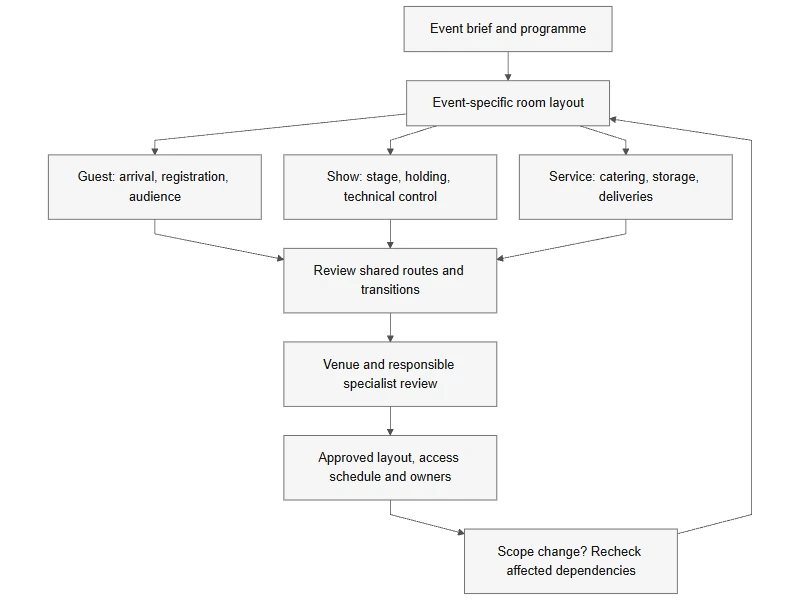
Request current room dimensions and a layout reflecting the proposed event. Show stage, screens, audience, circulation, control position and operational spaces. Ask the hotel and responsible specialists to review the design against the venue's requirements. A sales capacity is not a substitute for agreement on this particular arrangement.
Walk the least favourable viewing positions. Look at columns, chandeliers, soffits and other restrictions that might affect the proposed design. Ask the production team to demonstrate how the audience will see presentations and how presenters will move. Keep any technical calculations and approvals with the qualified people responsible for them; the event owner needs a decision and its implications, not an improvised engineering rule.
Compare two arrangements where the brief allows it. One may prioritise discussion at tables; another may prioritise attention towards a stage. Record how each affects room use, service and transitions. The approved layout should carry a version and date, so a later creative rendering does not quietly replace the operational plan everyone has accepted.
Make front-of-house and backstage real spaces
Front-of-house can mean guest-facing operations, but production teams also use FOH to describe an audience-side control position. Define the term in your documents. If a technical control position is required, ask the production lead where it needs to be and what it must accommodate. Include it before allocating every attractive area to guests.
Backstage should be more than a gap behind the set. Ask where speakers wait, where an award recipient enters, how presentation support communicates with stage management and where equipment cases go after installation. Confirm which routes remain usable once the set and furniture are in place. A visually hidden route may still conflict with hotel service.
The client should receive a functional zoning drawing with distinct guest, stage, control, support and service areas. It need not be complicated. Its value is in exposing competition for the same space while there is still time to adjust the design. Any accessibility, safety or technical approval belongs with the venue and the responsible specialists.
Confirm exclusive access, not just event timing
Write down four different milestones: when deliveries may arrive, when the ballroom is handed over, when rehearsal can begin and when guests enter. Then record the dismantling window and the deadline for returning the space. Ask the hotel to identify a preceding booking or other restriction that could affect those commitments without requesting another client's confidential information.
Give the production lead the access conditions before approving the set. The team should explain the planned sequence, the dependencies and what must be prepared elsewhere. If the programme requires rehearsal, its time must be protected in the schedule rather than described as something to do after setup if there is time left.
Agree an escalation route for delayed handover. Who confirms that the room is released? Who can authorise a change to the guest programme or a reduced production scope? The answer should be a named role and a communication method. A confirmed event start time does not by itself resolve the work that must happen before it.
Walk the entire delivery and removal route
Visit the loading area and follow the route to the ballroom with the people responsible for delivery planning. Ask about vehicle booking, waiting arrangements, lift reservations, door restrictions, floor protection and any required supervision. Have the relevant suppliers check that their planned equipment and packaging can move through the route. Do not rely on a description such as goods lift available.
Check temporary holding space at both ends. If deliveries arrive before the room is ready, where can items wait with the hotel's agreement? Once equipment is installed, where will empty cases and packaging be kept? At load-out, can the same route be used while guests are leaving and hotel service is continuing?
Turn the findings into a delivery schedule that separates arrival slots from permission to unload. Assign a person to coordinate the hotel and supplier movements. The aim is to prevent several teams treating a shared route as exclusively theirs, then losing installation time while they negotiate around each other.
Read the banquet package as a scope document
Ask the hotel to specify what the package includes, in what quantity, for which hours and under which conditions. Furniture, linen, refreshments, service staffing, room access, cleaning and basic AV may be described broadly in an initial offer. Request the detail needed to connect each inclusion to your event. A listed item may be useful, insufficient or unnecessary for the final format.
Create a three-way matrix: included by hotel, included by agency or supplier, and supplied by client. Every required item needs an owner. Where a hotel inclusion is replaced with external provision, clarify whether the commercial arrangement changes and whether any restrictions or additional services apply. Do not assume a listed inclusion automatically produces a credit when unused.
Record deadlines for menu decisions, final numbers and layout approval, along with the handling of later changes. Commercial and contractual terms should be reviewed by the client's authorised decision-makers. The event lead's role is to make operational consequences visible, so agreement is based on the event that will actually be delivered.
Compare hotel AV and external production against the brief
The relevant question is whether the proposed solution meets the programme, not whether hotel or external equipment is inherently better. Provide the same requirements to each proposed delivery team: content, speakers, audience arrangement, playback, recording or remote participation, rehearsal and support periods. Ask them to describe responsibility for the complete service.
Check interfaces where suppliers are combined. Who controls presentation changes? Who has authority over show cues? Who resolves an issue when one team's service depends on another team's connection or equipment? Ask for a practical ownership plan rather than accepting that the teams will coordinate on arrival.
Confirm venue permissions and commercial conditions for external suppliers in writing. Have technical specialists resolve compatibility, power and installation requirements. The client should see one coherent production scope, including operators and rehearsal, with any exclusions visible. That lets a choice be made on delivery and accountability instead of a superficial equipment list.
Give hospitality its place in the production schedule
Build the programme and banquet timing together. Coffee, lunch and dinner depend on guest movement, service preparation and clearance. The hotel needs to know when the audience is expected, how it will arrive and whether a session can run over. The event team needs to know what changes in service become difficult after preparation reaches a particular stage.
Ask the banquet lead how the proposed service interacts with doors, backstage routes and room resets. A service corridor that is available during installation may be active at a critical programme transition. Check these periods on a shared schedule instead of assuming the route has one function throughout the day.
Agree the person who communicates changes and the decision point for a revised meal time. Keep guest communications with the hospitality team, while recording the physical and timing dependencies in the venue plan. This prevents a programme adjustment from reaching the kitchen, transport team and stage team as three different instructions.
Plan transitions as events within the event
A conference-to-dinner change involves more than moving furniture. Guests need somewhere appropriate to go, the room needs a defined work period and teams need a sequence that avoids conflicting activity. Ask what is being removed, what is being installed and what can remain in place. Confirm where materials wait before and after the change.
Develop a transition sheet with the trigger, guest destination, work sequence, responsible leads and the person who releases the room. If the event uses two rooms, confirm the route and readiness of the receiving space. If it uses one room, test whether the holding area and programme genuinely accommodate the reset rather than depending on an optimistic estimate.
Include a contingency for a delayed transition. It may mean extending a planned activity or simplifying a nonessential change, subject to the responsible leads' approval. Do not promise a universal turnaround time. The right commitment comes from the actual design, staffing, venue conditions and agreed work plan.
Treat power, internet and technical approval as early decisions
The event owner should describe what needs to work and when: presentation, show lighting, content playback, registration, remote contribution or broadcast. Ask the production and venue specialists to translate that requirement into an approved technical plan. Obtain confirmation of responsibilities, access for testing and any additional costs before creative decisions make the solution harder to change.
For power, request a documented review between the supplier and hotel rather than asking a salesperson whether there is enough. For internet, define the intended event use and the support arrangement. Ask how the team will confirm readiness and what happens if the proposed service cannot support the agreed programme. Avoid treating a general property amenity as a dedicated event commitment.
Keep unresolved technical matters on the booking and production decision log. State the consequence of a negative answer: different design, additional provision, altered programme or unsuitable venue. This makes technical uncertainty a visible client decision, while leaving engineering design and safety judgments with those qualified to make them.
Build one hotel production schedule
Bring room access, delivery, installation, hotel preparation, rehearsals, guest activity, service and removal into one dated schedule. The document should show dependencies and handovers, not only the start time of each team. Include the event lead, hotel duty contact and relevant supplier leads with current communication details in the operational version.
Review collisions before distributing it: a lift needed by two deliveries, cleaning scheduled while construction remains active, a sound check during another protected activity or a dinner setup that requires guest space. Ask each owner to confirm the sequence relevant to their work and flag conditions they cannot meet.
Control changes through the event lead. When a time changes, identify the affected teams and confirm receipt. A schedule that has been shared once is not necessarily the schedule being used. Keep a clear current version and remove ambiguity about superseded copies, particularly as hotel shift handovers and supplier arrivals approach.
Illustrative scenario: access is shorter than expected
Imagine that the proposed ballroom handover leaves a much shorter preparation window than the creative proposal assumed. The risk is a chain reaction: installation consumes rehearsal, unfinished work delays room release and guest service begins around a production that has not been tested. Simply asking every team to work faster does not resolve that dependency.
The event lead should bring the hotel and production lead together to verify the actual constraint. Review earlier access to supporting areas, off-site preparation, alternative sequencing and a simpler design. Each option needs a confirmed operational effect and commercial consequence. The client owner chooses among feasible options; qualified leads retain responsibility for technical and safety decisions.
If the original scope cannot be delivered within confirmed conditions, change the scope, timing or venue rather than disguising uncertainty. The intended outcome is a programme supported by a credible preparation plan. This is an illustrative planning exercise, not a claim about a completed event or a guarantee that a particular workaround is always possible.
Questions to settle at the final hotel meeting
Use the final meeting to resolve ownership, not repeat a sales presentation. Ask who releases the room to production, who accepts it back and who has authority when the agreed schedule changes. Confirm whether the person attending that meeting will be present during the event, and how the duty team receives the approved documents if someone else takes over.
Ask each lead to identify their most important unresolved dependency. The banquet lead may need a final service time; the production lead may need access confirmation; the client may still be approving the audience layout. Record the answer and the consequence of missing its decision date. This makes the meeting useful even when not every detail can be closed immediately.
Finish by confirming the exact documents that now represent the agreement. A layout, a banquet order and an agency schedule should tell the same story. Where they differ, resolve the difference before teams begin preparing against conflicting instructions.
Before leaving the final planning meeting, test the handover documents with someone who was not involved in developing them. Can that person identify the room access time, authorised contact, current layout, storage agreement and route for an unresolved issue? If they must reconstruct the answer from several email threads, the handover is incomplete. Consolidate the confirmed information and identify which document takes precedence. Ask the hotel and event leads to acknowledge the same version before it is issued to suppliers and guest-facing teams.
Approve a booking pack, then close the event properly
Before commitment, assemble the approved layout, space schedule, access agreement, package matrix, technical open-item list and commercial terms. Ask the authorised client owner to review the remaining exceptions. An unresolved issue can be acceptable only when its consequence and decision route are understood; it should not disappear because a date is popular.
Before show day, update that pack into the operational version with contacts, handovers, current schedules and contingency decisions. After the event, confirm removal, return of spaces and any disputed additions with the relevant owners. Reconcile the final account against approved scope changes rather than memory.
Use the debrief to capture venue-specific facts for the next brief: which routes worked, which access commitments mattered and which package assumptions required clarification. For a new enquiry, share your format, guest range, date and venue status with ThreeSixZero. Those details let the venue discussion begin with feasibility and responsibility, before a room booking sets the rest of the event's limits.
Put the plan to work
Adapt these working tools to your event, venue and agreed responsibilities.
- Venue recce and decision worksheet
- Hotel package comparison worksheet